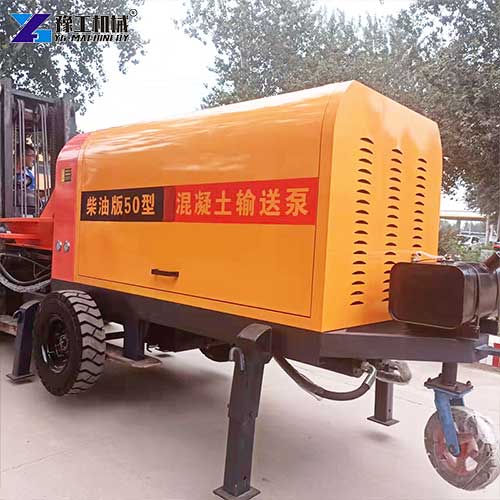
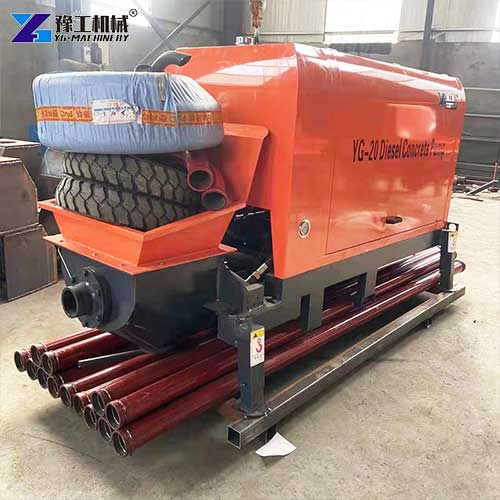
A small concrete pump machine is a self-contained hydraulic conveying system that pushes fresh concrete continuously through sealed pipelines via reciprocating piston pressure. Composed of a main pump unit, power drive system and matched conveying pipe assemblies, it delivers concrete directly to the exact pouring point without intermediate manual transfer, eliminating the inefficiency and material waste of bucket or wheelbarrow transportation. Unlike large truck-mounted pump trucks that require wide access roads and large operating space, this compact trailer-mounted concrete pump fits into narrow construction sites, low-rise building projects and indoor renovation work where heavy equipment cannot reach. It balances output capacity, space footprint and operational flexibility to serve as a practical solution for small to medium concrete pouring tasks.
Small Concrete Pump Machine Technical Parameters:
| Spec/Model | YG-10 | YG-20 | YG-30 | YG-40 |
| Work efficiency | 6m³/h | 12m³/h | 15-18m³/h | 20-22m³/h |
| Motor power | 15kw | 22KW | 37KW | 45KW |
| Working pressure | 15MPa/10MPa | 18MPa/12MPa | 18MPa/15MPa | 23MPa/15MPa |
| Aggregate size | 0.5-1.5cm | 0.5-2cm | 0.5-2cm | 0.5-2cm |
| Vertical/Horizontal conveying distance | 20m/50m | 40m/80m | 80m/100m | 120m/260m |
| Diameter of conveying pipe | 80mm | 80mm | φ80(100)mm | φ100(80)mm |
| Weight | 600KG | 1600kg | 2200kg | 2400kg |
| Dimensions | 1800*700*1100mm | 3400x1200x1600mm | 3800x1500x1600mm | 4000x1500x1550mm |
| Standard configuration | 10m steel pipe, 10m hose | 40m steel pipe, 10m hose | 90m φ80 steel pipe, 10m hose | 120m φ80 steel pipe, 10m hose |
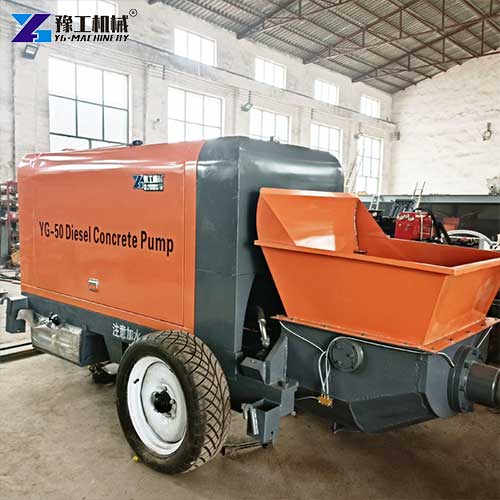
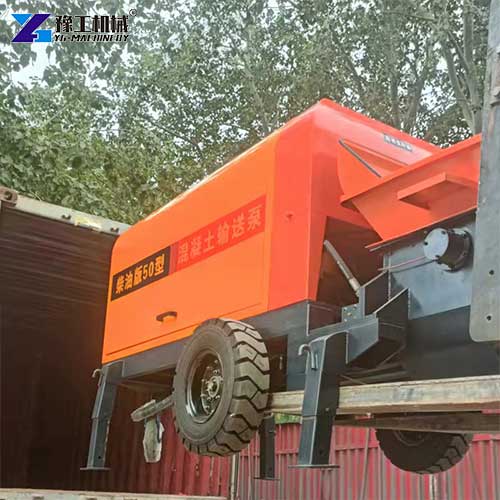
Case Study: Delivered to Malaysia – Solving Space and Efficiency Challenges
A construction contractor in Malaysia recently purchased a towable concrete pump from YG Machinery to solve several on-site concreting challenges. The contractor primarily undertakes residential projects, rural infrastructure construction, and foundation pouring work.
The challenges: Before adopting the new equipment, the customer relied mainly on manual concrete transportation and traditional mixing methods, which were slow, labor-intensive, and often resulted in inconsistent concrete placement. Several problems repeatedly affected project progress:
- Limited construction space. Many construction sites were located in narrow urban areas where large pumping equipment could not enter.
- High labor costs. Manual concrete transportation required many workers carrying buckets or using wheelbarrows.
- Low pouring efficiency. Traditional concrete placement methods slowed down construction schedules.
- Uneven concrete quality. Manual handling sometimes caused segregation or inconsistent pouring results.
The solution: The contractor needed a compact, reliable, and easy-to-transport solution. After comparing several suppliers, the Malaysian contractor chose the YG small concrete pump machine for several reasons: compact structure for small construction sites, stable pumping performance with continuous concrete delivery, easy transportation between multiple project sites, and affordable pricing compared to large truck-mounted pumps.
The results: After receiving the trailer-mounted concrete pump and completing a short training session, the customer quickly put the towable concrete pump into operation.
- Significant efficiency improvement. Previously, pouring a small residential foundation required 6-8 workers and several hours of labor. With the small concrete pump, the contractor now completes the same job in less than half the time, using fewer workers.
- Reduced labor costs. The company reduced the number of workers required for concrete transportation and placement, which lowered overall project costs.
- More consistent concrete quality. The small concrete pump machine ensures continuous and uniform concrete flow, helping achieve better structural quality.
- Increased project capacity. Thanks to improved efficiency, the contractor can now take on more projects simultaneously, increasing overall revenue.
Customer feedback: After several months of operation, the customer shared positive feedback: “The small concrete pump machine from YG Machinery works very well on our projects. It is easy to operate, reliable, and helps us complete jobs faster. The investment was definitely worth it.” The customer is now planning to purchase another unit as their business continues to expand.


How to Select a Small Concrete Pump Machine?
The right pump is determined by three numbers: the volume of concrete per pour, the distance it needs to travel, and the aggregate size in the mix.
- Volume determines the model. A 10 m³ foundation pour does not need a 40 m³/h pump. The YG-10 at 6 m³/h completes that pour in under two hours—plenty fast for most residential work. A 50 m³ commercial slab needs the YG-40 at 20-22 m³/h to keep the pour moving without cold joints.
- Distance determines the power. Vertical pumping requires more pressure than horizontal. The YG-10 trailer-mounted concrete pump reaches 20 meters vertically (about 6 stories). The YG-40 reaches 120 meters (about 36 stories). If you are pumping to the top of a mid-rise building, the larger models are not optional—they are essential.
- Aggregate size determines the pipe. The YG-10 small concrete pump machine handles 0.5- 1.5 cm aggregate. The YG-20 through YG-40 handle up to 2cm. If your mix contains larger stone, the pump will block. This is a common mistake that costs hours of downtime.
The YG series is designed for fine aggregate concrete—the type used in most residential, commercial, and mid-rise construction. The S-valve design handles these mixes reliably, with less sensitivity to slump variations than gate-valve pumps.
Daily Maintenance That Saves You from Costly Downtime
Most concrete pump breakdowns don’t happen suddenly. They are the result of days or weeks of neglect. Daily maintenance takes 15 minutes. Fixing a failed pump takes days and costs thousands. Here is what matters most.
1. Clean the pipeline immediately after every pour
Concrete left in the pipe hardens overnight. The next day starts with hours of cleaning or replacing blocked pipes. Use sponge balls with high-pressure water or air immediately after each pour. When using compressed air, keep personnel at least 10 meters clear of the pipe outlet.
2. Check the S-valve and wear plates daily
The S-valve, cutting ring, and wear plate direct concrete from the hopper to the cylinders. When the gap exceeds 0.7mm, adjust the bolts back to 0.1- 0.2 mm. After 3- 4 mm of total adjustment, replace the parts. A worn S-valve means pressure loss, reduced output, and concrete leakage.
3. Rotate the cutting ring after 60-80 hours
Simply rotating the cutting ring 90° doubles its service life. Not doing this means replacing it twice as often.
4. Keep the hydraulic system clean
Check the oil level daily—it must stay between 1/2 and 2/3 on the sight glass. Oil temperature must stay below 70°C. Change hydraulic oil and filter after the first 500 hours, then every 6 months. Clean the radiator daily. Contaminated oil is the leading cause of pump failure.
5. Lubricate all moving parts daily
Add grease to all lubrication points before starting. Run the pump for 5 minutes and check that grease flows from the S-valve arm and bearings. If no grease appears, the system is not lubricated.


Concrete Pump Machine For Sale
If you are looking for a reliable concrete pump machine for sale for your upcoming construction projects, or if you need help matching the right unit to your specific conveying distance and aggregate requirements, reach out to our team today. We will provide detailed technical specifications and a tailored configuration recommendation to match your exact needs.