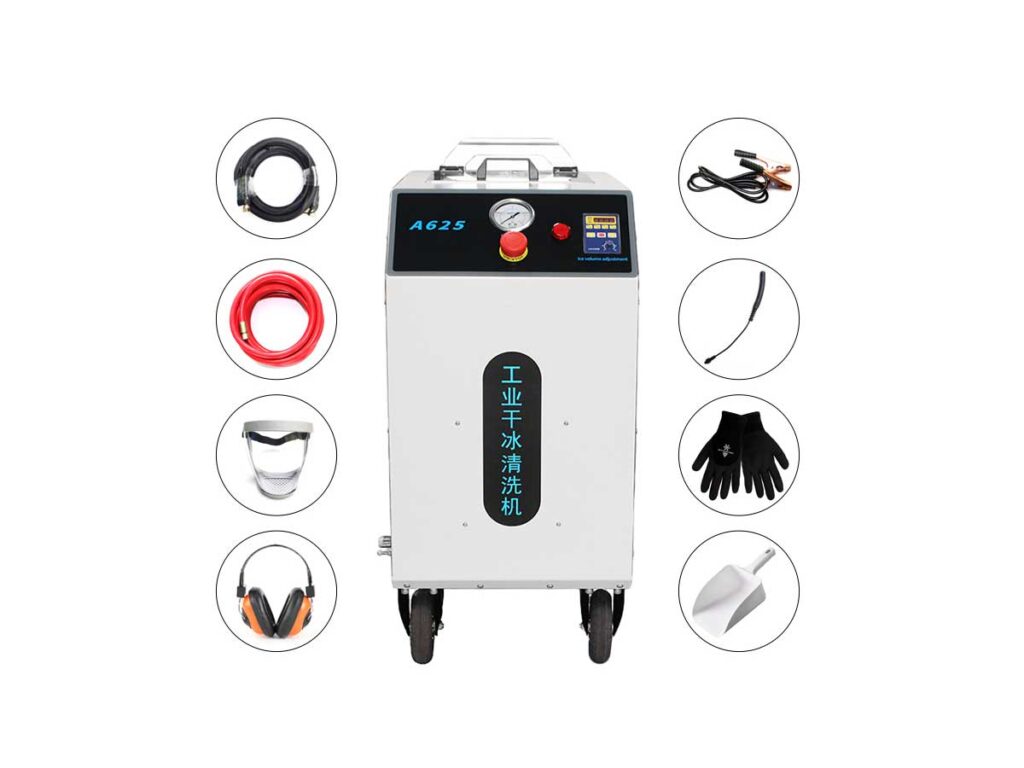


A dry ice sand blaster is a cleaning system that uses compressed air to accelerate dry ice pellets toward a surface, removing contaminants through a combination of kinetic energy, thermal shock, and sublimation. Unlike abrasive blasting methods that use sand, glass, or other media, a dry ice sandblasting machine leaves no secondary waste because the pellets vaporize on impact. The process works without water, chemicals, or abrasive media. This makes it suitable for a wide range of industrial cleaning tasks where traditional methods would cause damage, require lengthy disassembly, or leave behind residue that needs cleanup. Food processing plants, automotive factories, power generation facilities, and printing operations all rely on this technology for regular maintenance cleaning.
Dry Ice Sand Blaster Technical Specifications
| Model | ICE-JET 3.0 | ICE-JET 6.0 | ICE-JET 15 | ICE-JET 40 |
| Dry Ice Capacity | 3KG | 6KG | 15KG | 40KG |
| Dry lce Consumption | 20-50KG/H | 20-50KG/H | 30-100KG/H | 30-100KG/H |
| Supply Pressure | 3-10bar | 13-10bar | 3-10bar | 3-10bar |
| Air Consumption | 1-2m³/min | 1-3m³/min | 1-4m³/min | 1-5m³/min |
| Weight | 40KG | 50KG | 65KG | 80KG |
| Dimensions | 460x340x750mm | 460x350x850mm | 550x445x985mm | 650x550x1000mm |
| Total Power | <500W | <800W | <800W | <800W |
How Does Dry Ice Sand Blaster Works?
First, kinetic energy does the initial work. Compressed air accelerates the dry ice pellets to high speed, and when they hit the surface, the impact breaks up the top layer of contamination. This is similar to other blasting methods, but with a key difference — the medium is soft and evaporates immediately.
Second, thermal shock plays a critical role. Dry ice has a temperature of around -78.5 degrees Celsius. When it hits a warmer surface, the sudden temperature drop causes the contaminant layer to contract and crack. This thermal contraction breaks the bond between the contaminant and the substrate, making it easier to remove.
Third, sublimation completes the process. The dry ice pellets go directly from solid to gas on contact, expanding by roughly 800 times in volume. This expansion creates a micro-explosion effect that lifts the cracked contaminant away from the surface. Because the ice turns into carbon dioxide gas, there is no blasting media left behind to clean up.
The combination of these three effects — impact, contraction, and expansion — is what makes dry ice cleaning so effective on a wide range of surfaces and contaminant types.


Key Applications of the YG Dry Ice Sand Blaster
Dry ice blasting serves a surprisingly broad range of industries. Any operation that needs to clean equipment, molds, or surfaces without causing damage and without lengthy downtime is a candidate for this technology.
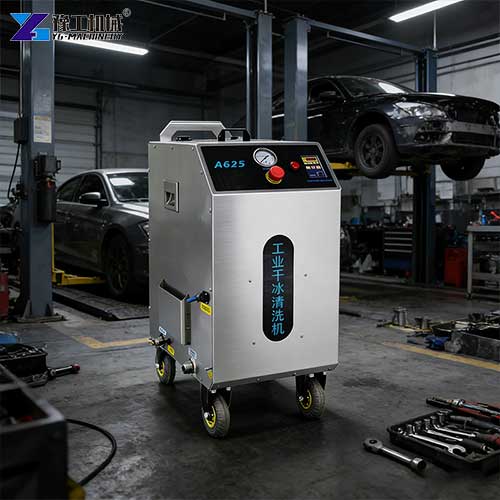
- Food and beverage processing is one of the largest users. Plants use the dry ice sandblasting machine to clean production lines, ovens, conveyors, and packaging machinery. Because the process uses no chemicals and leaves no residue, it meets strict food safety standards. A portable dry ice blaster works well for moving between different production areas in a facility.
- Automotive manufacturing and mold cleaning are other major applications. Foundries and die casting operations use dry ice to remove release agents, excess material, and buildup from molds and dies. The ability to clean in place without disassembly saves significant time compared to traditional mold cleaning methods.
- Power generation and electrical equipment benefit from the non-conductive nature of dry ice. An industrial dry ice blaster can clean transformers, generators, motors, and switchgear without risk of electrical damage. The non-abrasive nature also means it will not damage winding insulation or delicate components.
- Printing and packaging operations use dry ice to remove ink residue, adhesive buildup, and paper dust from printing presses, rollers, and packaging equipment. Regular cleaning maintains print quality and reduces downtime caused by contaminated machinery.
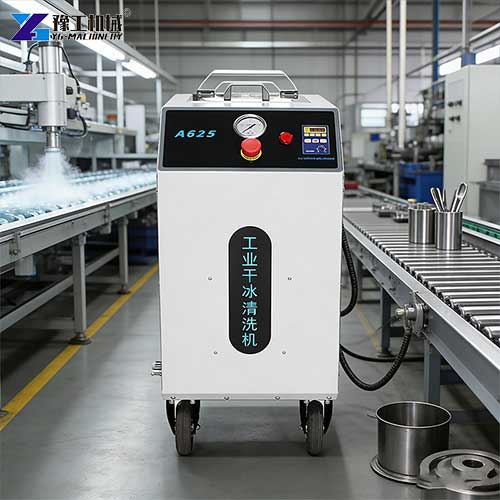
How Does YG Dry Ice Sand Blaster Outperform Traditional Models?
Not all portable dry ice blasters are built the same. Design differences in the drive system, transmission, electrical layout, and nozzle construction directly affect performance, reliability, and maintenance needs.
- Dual-motor drive vs. single-motor design. Our system uses two separate motors — one for ice feeding, one for the mixing shaft — so each runs at optimal speed. This delivers high-frequency blasting with consistent ice output at any setting. Traditional single-motor machines suffer from intermittent spraying at lower volume settings, which reduces coverage and extends cleaning time. The single motor also wears faster from continuous high-frequency operation.
- Gear-driven cutter vs. chain-driven design. Our integrated gear cutter disc transfers power directly through gears — efficient, responsive, and virtually maintenance-free with low failure rates. Traditional chain and sprocket systems develop ice buildup from the cold temperatures, causing seizing, rust, and accelerated wear. They need regular cleaning and lubrication, and stretched chains can cause the cutter to slip, resulting in inconsistent ice flow.
- Independent control box vs. bottom-mounted design. Our control box sits separately from the cold chamber, away from condensation and moisture. Traditional models often mount controls at the bottom of the cold storage area, where condensation can drip into electrical components and cause short circuits. Separating the controls from the cold zone eliminates this issue and extends component life.
- Built-in nozzle filter vs. unfiltered flow. Our blasting gun includes a filter that breaks large ice particles into uniform sizes before they exit the nozzle. This prevents oversized chunks from damaging delicate surfaces and ensures consistent cleaning results. Without a filter, larger ice pieces can pass through and cause uneven cleaning or surface damage on sensitive materials.

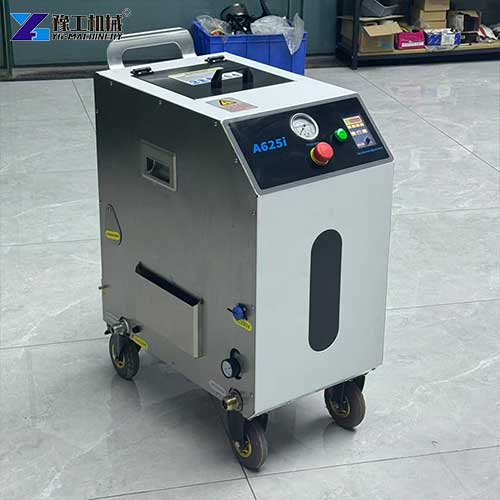
5 Frequently Asked Questions About Dry Ice Sand Blaster
A: Yes. Dry ice blasting is non-abrasive and does not etch or wear most surfaces. It is safe for use on precision equipment, electrical components, soft metals, and finished surfaces where abrasive blasting would cause damage. The key is using the correct pressure, nozzle distance, and ice pellet size for the specific surface.
A: In most cases, no. One of the biggest advantages is the ability to clean equipment in place, while it is still assembled and often while it is running. This eliminates the time and labor cost of disassembly and reassembly. You do need to take normal safety precautions for moving parts and electrical systems.
A: Most systems use standard dry ice pellets, typically 3 mm in diameter. The exact size and quality can affect cleaning performance and how quickly the ice feeds through the machine. Using fresh, high-quality dry ice gives the best results.
A: Yes, when proper procedures are followed. Dry ice is non-conductive, and the process uses no water. You should still follow standard electrical safety practices — de-energize equipment when possible, maintain appropriate distances, and use proper personal protective equipment. Always consult the equipment guidelines for your specific electrical application.
A: Like any compressed air system, dry ice blasting produces noise. The exact level depends on the pressure, nozzle size, and distance. Operators should wear appropriate hearing protection as they would with other air-powered equipment. Enclosing the work area or using sound-dampening equipment can reduce noise for surrounding areas.