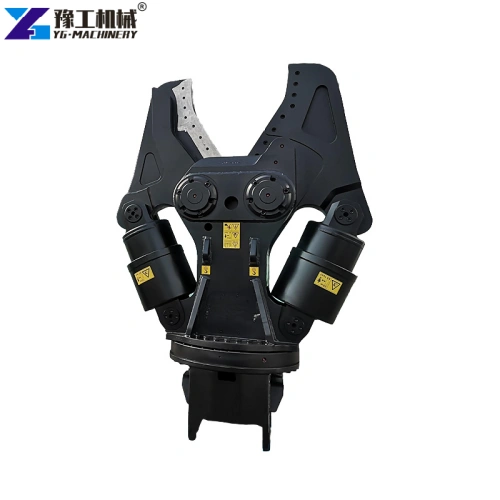

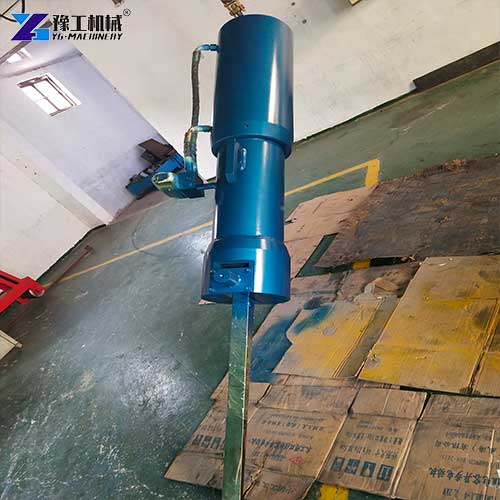
An excavator rock splitter is a hydraulic attachment that mounts to an excavator arm and uses amplified hydraulic force to split rock and concrete from the inside out, without blasting, vibration or noise. Traditional rock breaking methods — drilling and blasting, hydraulic hammers, or mechanical breaking — each have significant limitations. Blasting requires permits, creates vibration and flyrock, and cannot be used near existing structures or in urban areas. Hydraulic hammers produce high noise and vibration, and their impact energy is inefficient for hard, massive rock formations because much of the energy dissipates at the surface rather than penetrating the rock mass. Mechanical breaking with buckets or rippers only works on soft, fractured rock and cannot handle intact, hard formations.
Excavator Rock Splitter Technical Specifications:
| Model | YGM-S200 | YGM-S280 |
| Splitting Force(ton) | 3800 | 5700 |
| Piston Diameter(mm) | 200 | 250 |
| Required Drilling Diameter(mm) | 90-110 | 110-130 |
| Required Drilling Depth(mm) | 1600 | 1700 |
| Crack Width(mm) | 32 | 35 |
| Drilling Gap Distance(mm) | 1000-1500 | 2000-2500 |
| Splitting Speed(s) | 40-50 | 40-50 |
| Required Pressure(MPa). | 60-80 | 80 |
| Splitting Gun Length(mm) | 2700 | 2800 |
| Weight(kg) | 900 | 1000 |

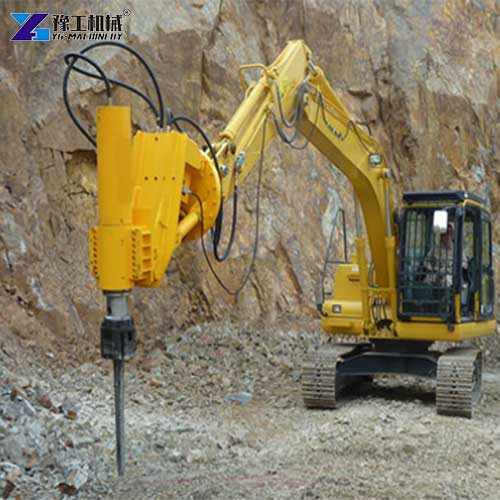
How an Excavator Rock Splitter Works?
The working principle is based on a simple but powerful concept: the wedge principle. The excavator provides hydraulic power to the splitter. High-pressure hydraulic oil flows through the pipelines into the splitter body, driving the hydraulic cylinder. The piston moves forward, pushing the middle wedge into the wedge group. This action forces two reverse wedges outward against the inner walls of the pre-drilled hole.
When the expansion force exceeds the tensile strength of the rock, the rock fractures from the inside out. The splitting force is concentrated precisely where it is needed—no impact, no shock waves, no flying debris. By controlling the hydraulic system, the operator can accurately control the size and direction of the splitting force.
Unlike hydraulic breakers that pound the surface with repeated impacts, a rock splitter for excavator applies static pressure from inside the rock. The cracking is controlled, predictable, and silent. The entire process is fast, smooth, and fully controllable.
4 Applications of Excavator Rock Splitter
- Quarrying and Dimension Stone Extraction: Stone quarries require clean splitting of rock blocks without damaging the material. The rock splitter machine produces straight, controlled fractures that preserve block integrity. Unlike blasting, which can micro-fracture the stone and reduce its value, the splitter delivers clean, saleable blocks.
- Tunnel and Subway Excavation: Tunnel construction often occurs in urban areas with strict vibration limits. The excavator splitter provides low-vibration rock removal that maintains tunnel stability and protects existing structures. It is widely used in tunnel and subway engineering where explosives are prohibited.
- Mining Operations: In metal mining and cave mining, the rock splitter for excavator enables selective extraction of ore without diluting the material with surrounding waste. It is particularly valuable in narrow-vein mining where precision is critical.
- Foundation Excavation and Demolition: Building foundations often encounter rock that must be removed. The rock splitter machine removes rock cleanly without damaging adjacent structures. In demolition, it breaks up reinforced concrete and rock foundations with minimal disruption.


4 Features of Excavator Rock Splitter
- Integrated hydraulic booster system: The integrated booster system amplifies the excavator’s standard hydraulic pressure into much higher splitting force at the wedge assembly, using a hydraulic intensifier with differential piston area. This allows the splitter to generate tons of splitting force using standard excavator hydraulics, with no oversized power unit or custom modification required.
- No-deformation splitter bar design: The splitter bar — central wedge and two outward-expanding side wings — is manufactured from high-strength, wear-resistant steel with precise machining tolerances. Its specialized structural design maintains shape and performance through repeated splitting cycles without deformation, ensuring consistent hole fit and force delivery over long service life.
- Excavator-mounted versatility and reach: Mounting to the excavator arm provides reach, lifting capacity and tracked mobility for positioning the splitter at various heights and angles — horizontal tunnel faces, vertical rock outcrops, angled slope faces. The same excavator that powers the splitter can also lift and move split rock pieces, reducing the need for multiple machines on site.
- Quick installation and simple operation: The excavator rock splitter mounts with standard pin connections and quick-connect hydraulic couplings, requiring no excavator modification and typically under one day for installation. Operation is straightforward — insert the bar into the pre-drilled hole, activate split from the cab, hold pressure until the rock cracks, then retract and move to the next hole. Operators familiar with excavator attachments learn the splitter quickly with no specialized certification.


7 FAQs About Excavator Rock Splitter
A: The YG series requires a minimum 15-20 ton excavator. The splitter connects to the excavator’s auxiliary hydraulic circuit and uses the machine’s hydraulic power. The 900- 1000 kg weight is within the lifting capacity of most medium excavators.
A:3,800 tons (YGM-S200) handles most quarrying and demolition applications—granite, limestone, sandstone, and reinforced concrete. 5,700 tons (YGM-S280) handles ultra-hard rock, massive boulders, and heavily reinforced structures where extra force is needed.
A: No. The YG excavator splitter features an integrated booster system built into the splitter. It connects directly to the excavator’s auxiliary hydraulic circuit—no external pump station required.
A: The YGM-S200 requires 90- 110 mm diameter holes. The YGM-S280 requires 110- 130 mm diameter holes. Standard rock drills and DTH hammers can drill these diameters.
A: The YGM-S200 requires 1600mm hole depth. The YGM-S280 requires 1700mm hole depth. The deeper the hole, the more rock the splitter can fracture in a single cycle.
A: Each splitting cycle takes 40-50 seconds from insertion to rock fracture. For a large rock requiring multiple holes, the total cycle time is the number of holes multiplied by 40-50 seconds.
A: The YGM-S200 produces a 32 mm crack width. The YGM-S280 produces a 35 mm crack width. This width is sufficient to separate rock blocks for removal without secondary breaking.