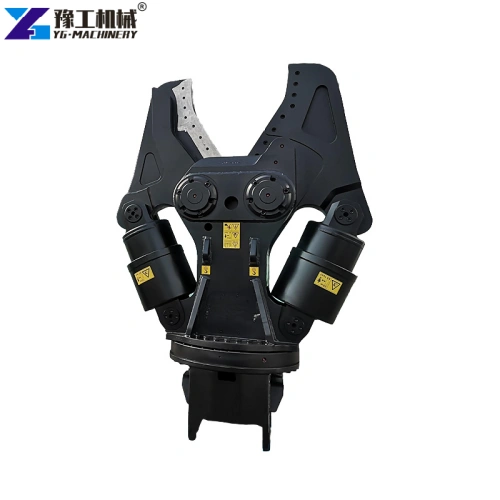


A pile breaking machine is an excavator‑mounted hydraulic work attachment built to cut off concrete pile heads through synchronized radial compression. It connects to an excavator’s existing hydraulic output, and contractors deploy this tool to remove excess sections on cast‑in‑place piles and precast piles across foundation construction sites. Instead of manual jackhammer work or explosive demolition, this pile breaking machine applies evenly distributed hydraulic force around pile perimeters to generate clean cross‑section breaks. The hydraulic pile cutter runs on multi‑cylinder synchronized pressure, and this machine delivers uniform stress distribution to prevent uncontrolled cracking that can damage usable pile sections underneath the cut plane.
Pile Breaking Machine Technical Specifications:
| Module Number | PCS | 4 | 8 | 9 | 10 | 11 | 12 | 13 | 14 | 15 | 16 | 17 | 18 |
| Single-module weight | KG | 1600 | 2640 | 2970 | 3300 | 3630 | 3960 | 4290 | 4620 | 4950 | 5280 | 5610 | 5940 |
| Pile diameter range | mm | 400-600 | 600-800 | 800-1000 | 1000-1150 | 1150-1300 | 1300-1500 | 1500-1650 | 1650-1800 | 1800-1970 | 1970-2200 | 2200-2360 | 2360-2500 |
| Hydraulic excavator | T | 20T-30T | 30T-40T | Hydraulic system/pump station | |||||||||
| Max.Thrust | 300KN | Max.Cylinder required | 20L/min | Machinery Tonnage | ≥20T | Location pinΦ35 | |||||||
| Max.Cylinder Trip | 300mm | Chisel diameter | 110mm | Single-module weight | 335KG | ||||||||
| Max.Cylinder Pressure | 300MPa | Max.Hoist Capacity | ≤500mm | Single-module size | A combination of the total weight | ||||||||


Why YG Pile Breaking Machine Stands Out?
- Modular design covers more pile diameters. One machine handles 400mm to 2500mm piles. Add modules for larger piles, remove for smaller ones. Reconfigure in minutes, not hours.
- Fits more excavators. No need for a special machine. 20-30 ton excavators handle up to 13 modules. 30-40 ton machines handle up to 16 modules. For the largest piles, a separate hydraulic pump station does the work.
- Low fuel consumption. Each pile consumes under 0.5 liters of diesel. Over hundreds of piles, the fuel savings add up significantly.
- One set of modules for round and square piles. The same modules that form a round ring reconfigure into a square frame with four connecting blocks. One investment covers both pile types.
- Fast service, low parts cost. Identical modules mean standardized parts. Replacement parts are stocked and available. Faster response time means less downtime on the job.
4 Things to Confirm Before You Buy a Pile Breaking Machine
Before recommending a hydraulic pile cutter configuration, confirm these four details with your customer. Getting them wrong means the machine will not fit, will not work, or will damage the pile.
1. Pile Type – Round or Square?
This is the first question. Round piles use the circular module configuration. Square piles require the square frame with connecting blocks. If the customer is unsure, ask them to send a photo. A quick visual check prevents the wrong configuration from being ordered.
2. Pile Diameter – What Is the Widest Point?
Pile diameter directly determines the module count. Measure the pile at its widest point—not the design diameter. Cast-in-place piles often have irregular heads that are larger than the specified diameter. If the customer measures the narrowest point, the module ring will not fit.
3. Concrete Strength – C30 or C50?
Standard concrete (C30-C40) works with the standard 160mm modules. High-strength concrete (C50-C80) requires the 180mm heavy-duty modules. If the customer does not know the concrete strength, ask about the project type: residential and commercial foundations are typically C30-C40; bridge and highway piles are usually C50 or higher. For high-strength concrete, recommending 180mm modules prevents underperformance.
4. Site Conditions – Power, Access, and Pile Layout
Does the site have power? Will the excavator provide hydraulic power, or does the job require a separate hydraulic pump station? Is the site level or sloped? Are piles spaced tightly together or spread out? Tight pile spacing may require the claw-type configuration. Limited access may affect how the pile chipping machine is delivered and positioned. These conditions determine which configuration and power source are appropriate.
Once you have answered these four questions, the right configuration becomes clear. The module count, power source, and machine type all follow from these details.
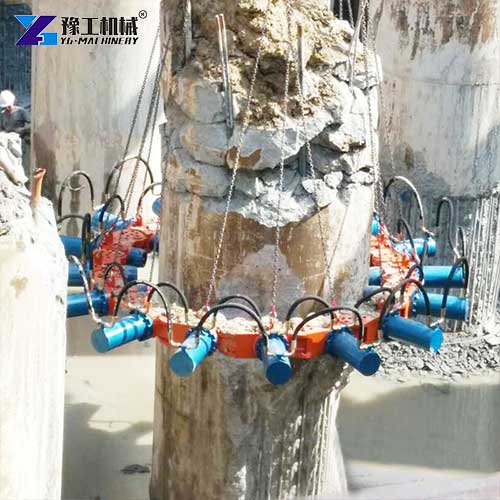
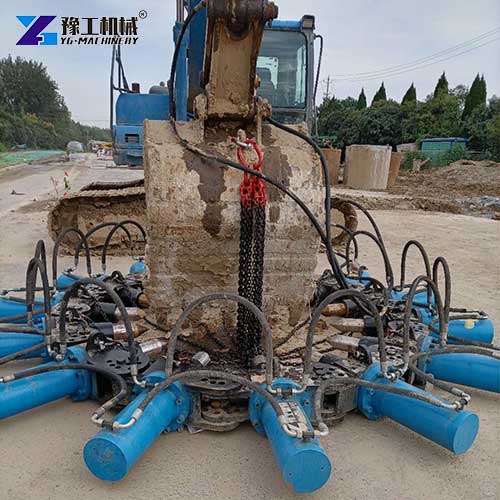
Concrete Pile Breaker vs Hydraulic Breaker
Many job sites still break pile heads with hydraulic breakers. Breakers get the job done—but they do it by force. Repeated high-impact blows shatter the concrete, and the shock waves travel down the pile shaft.
The problem: Those shock waves do not stop at the cut line. They travel into the part of the pile that stays in the ground, causing micro-cracks and internal damage that you cannot see. The pile looks intact on the outside, but its structural integrity has been compromised. Over time, water penetrates those micro-cracks, reinforcing steel corrodes, and the pile loses load-bearing capacity.
A pile breaking machine uses static hydraulic pressure instead of impact. Multiple cylinders press against the pile head simultaneously, applying steady, controlled force until the concrete fractures along the cut line. The force stays entirely within the section being removed—it does not travel down the pile shaft. The process leaves the remaining pile intact, with no micro‑cracks, no hidden damage, and no loss of load‑bearing capacity.
The efficiency difference: A pile breaking machine completes each pile in minutes with one operator. Manual methods with jackhammers take 30-60 minutes per pile with a crew of 4-5 workers. The time saved per pile is substantial.
The noise difference: A hydraulic breaker is loud—loud enough to cause complaints in urban areas. A pile chipping machine operates at a fraction of the noise level, making it suitable for nighttime work and noise-sensitive sites.
The bottom line: A breaker is for demolition—breaking concrete that is coming out. A pile breaking machine is for precision—removing only what needs to be removed and leaving the rest intact. Pile foundations are structural elements that cannot afford hidden damage. Choosing the right tool is not just about speed—it is about structural integrity.


Concrete Pile Breaker For Sale
YG manufactures this concrete pile breaker around modular design principles to serve varied global foundation project requirements. The assembly supports flexible module reconfiguration to match 400‑2500 mm wide‑ranging pile diameter specifications, with compatibility for 20‑40T multiple excavator carrier sizes. It works for square piles, round piles and adapts to demanding site conditions including waterfront and dense urban construction zones. If your upcoming project includes concrete pile head removal work, share your pile diameter, pile shape and carrier machine specifications to receive targeted configuration guidance for your construction job.