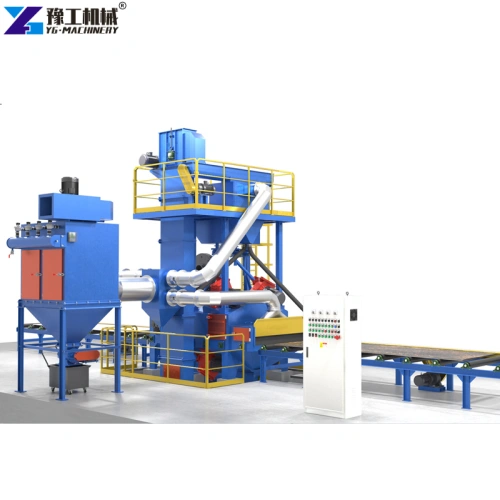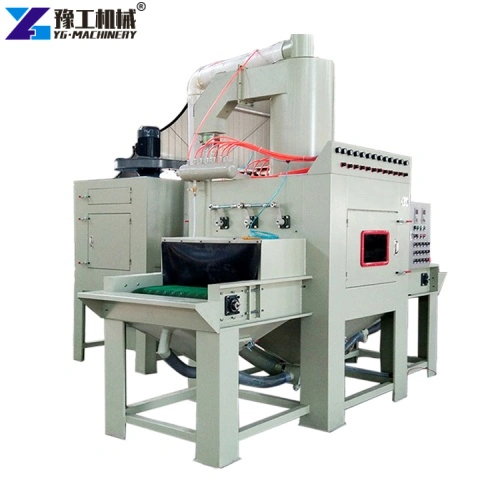


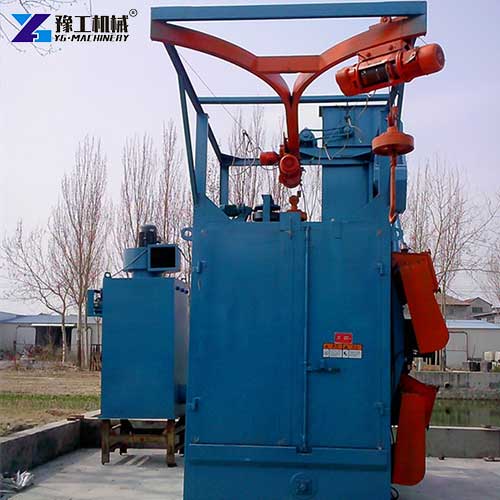
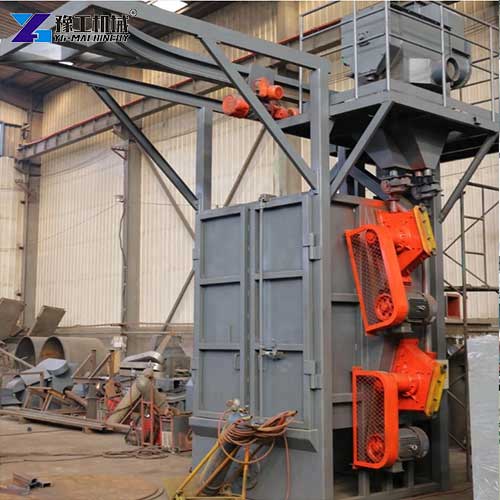
A hanger-type shot blasting machine is a batch-operated surface treatment system that suspends workpieces from rotating overhead hooks to deliver 360-degree abrasive blasting coverage. It removes rust, mill scale and residual foundry sand from complex, irregularly shaped and heavy components that flat conveyor machines cannot process fully. Also known as a hook-type shot blasting machine, it rotates hung workpieces inside a sealed blasting chamber to ensure uniform cleaning even on parts with deep cavities, undercuts and complex geometries. A spinner hanger shot blasting machine is the standard solution for foundries, forging shops and fabrication facilities working with bulky, non-flat metal components.
Hanger Type Shot Blasting Machine Technical Specifications:
| Item | YG376 | YG376B | YG378 | YG3710 | YG3720 | YG3730 | YG3750 | YG37100 |
| Maximum weight of cleaning(KG) | 500 | 600 | 800 | 1000 | 2000 | 3000 | 5000 | 10000 |
| Clean the workpiece size(mm) | 600*1200 | 700*1200 | 1000*1600 | 1200*1800 | 1400*2200 | 1600*2300 | 1800*2500 | 3000*3000 |
| Shot blasting amount (kg/min) | 2*200 | 2*200 | 2*250 | 2*250 | 3*250 | 3*250 | 4*250 | 5*250 |
| Lift (T/h) | 24 | 24 | 30 | 30 | 45 | 45 | 60 | 75 |
| Separator separation amount (T/h) | 24 | 24 | 30 | 30 | 45 | 45 | 60 | 75 |
| Power (KW) | 22.5 | 23.5 | 39.65 | 47.5 | 56.2 | 65.45 | 85.45 | 97.65 |
| Ventilation(m3/h) | 4000 | 4000 | 5000 | 5000 | 9000 | 11000 | 14000 | 16000 |

Hanger Type vs Roller Conveyor Shot Blasting Machines
When choosing between surface treatment equipment formats, matching the design to your workpiece traits ensures optimal cleaning efficiency and quality.
- Workpiece shape adaptability: Roller conveyor machines work best for flat, elongated workpieces such as steel plates, profiles and sheet metal. A spinner hanger shot blasting machine excels at irregular, bulky and three-dimensional parts including castings, forgings and welded structures, with rotating hooks eliminating contact blind spots.
- Production operation mode: Roller conveyor systems run in continuous through-feed mode for high-volume uninterrupted production. Hanger systems operate in timed batch cycles, with dedicated loading and unloading stations for each processing run.
- Weight capacity range: Roller conveyor designs have load limits tied to their roller bed rating, mostly for flat and relatively light materials. Hanger systems support much higher single-workpiece weights across their model range to accommodate heavy cast and forged parts.
- Finishing coverage consistency: Roller conveyor setups often leave small untreated areas where workpieces rest on the rollers. Rotating hanger designs suspend parts fully during blasting, delivering complete all-around coverage with no missed contact surfaces.
This targeted design makes the hanger-type shot blasting machine the better fit for complex, heavy and geometrically diverse part processing.
How Does a Hanger Type Shot Blasting Machine Work?
The YG series hanger-type shot blasting machine follows a straightforward process:
Loading. Workpieces are hung on hooks or fixtures outside the blasting chamber. The operator can use a manual hoist, forklift, crane, electric hoist, or robot to position the workpieces. The hooks are designed to accommodate different workpiece shapes and sizes.
Entry. The hook system transports the workpieces into the blasting chamber on an overhead track. The system can be configured as I-track, Y-track, or circular closed-loop monorail conveyors. Once the workpieces are inside, the chamber door closes automatically and locks electro-pneumatically.
Blasting. Multiple blast wheels propel abrasive at the rotating workpieces. The workpieces rotate continuously during blasting, ensuring all surfaces are exposed to the abrasive stream. The number of blast wheels ranges from 2 to 5 depending on the model.
Abrasive recirculation. Spent abrasive falls through perforated floor plates into a hopper beneath the chamber. A screw conveyor moves the abrasive to a bucket elevator, which lifts it to the top of the machine. A separation system removes oversized particles and fines. The cleaned abrasive is then returned to the blast wheels for reuse.
Unloading. After the blasting cycle is complete, the chamber door opens and the workpieces exit. The operator unloads the cleaned workpieces and loads the next batch.
The entire process is controlled by a programmable logic controller (PLC) that manages blasting time, wheel speed, and other parameters.

7 Applications of Hanger Type Shot Blasting Machine
The YG series hook type shot blasting machine serves multiple industries:
- Foundries. Castings of all types—iron, steel, aluminum, and other alloys—require cleaning after molding. The hanger type machine handles the variety of shapes and sizes typical in foundry production.
- Forging Shops. Forgings develop scale during heating and require descaling before further processing. The machine removes scale efficiently.
- Automotive Parts Manufacturing. Engine blocks, cylinder heads, transmission housings, brake components, and wheel hubs all require surface cleaning. The hanger-type machine is widely used in automotive plants.
- Heavy Machinery and Equipment. Large fabricated structures, gearboxes, and machine tool components require cleaning before painting or assembly.
- Steel Construction and Pressure Vessels. Welded structures, tanks, and pressure vessels require surface preparation before coating. The hanger-type machine handles these large, heavy workpieces.
- Shipbuilding and Marine. Components for ships and offshore structures require thorough cleaning to remove scale and prepare surfaces for protective coatings.
- Aerospace. High-precision components require controlled surface cleaning and strengthening. The hanger-type machine provides the accuracy needed for aerospace applications.


Workpiece Hanging Optimization Practices
To maximize performance of your hanger-type shot blasting machine and extend its service life, follow these practical hanging guidelines for daily on-site operation.
Balance load distribution across the hook. Uneven weight distribution causes wobbling during rotation, which reduces cleaning uniformity and accelerates wear on the hanger bearing and rotation mechanism.
Strictly observe the rated maximum load limit. Exceeding the weight rating puts excess strain on the overhead elevator and hanger drive system, raising the risk of premature component failure and safety hazards.
Orient workpieces to expose critical surfaces to blast wheels. For parts with deep cavities or internal features, angle them to allow abrasive media to reach recessed areas for full coverage, reducing the need for post-blasting manual touch-up.
Use minimal-contact hanging fixtures. Fixtures with small contact points reduce untreated blind spots on workpieces, and also minimize abrasive wear on the fixtures themselves to lower replacement costs.
Hanger Shot Blasting Machine Price
Every hanger type shot blasting machine from YG undergoes full-load factory testing before shipment to verify cleaning uniformity, abrasive circulation efficiency and dust containment performance. We design each model with a fully balanced system configuration to ensure stable long-term operation under heavy daily use. Our full model matrix covers all common load and size specifications, and we can also provide custom adjustments for special workpiece requirements.
If you are sourcing a durable hook-type shot blasting machine for your foundry, forging or metal fabrication operation, reach out to our team today. We will recommend the most suitable configuration based on your workpiece parameters, daily throughput and surface treatment requirements, and provide detailed specification sheets for a reliable hanger shot blasting machine price tailored to your needs.