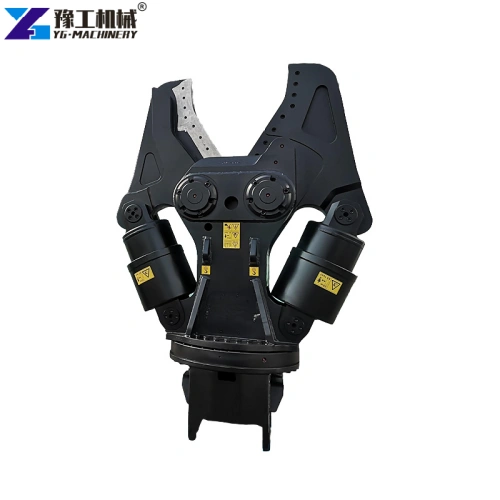
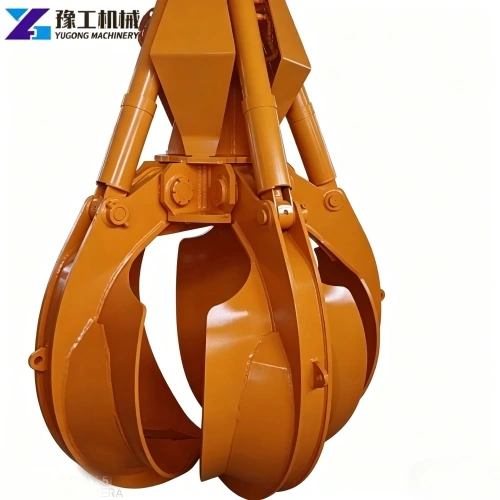
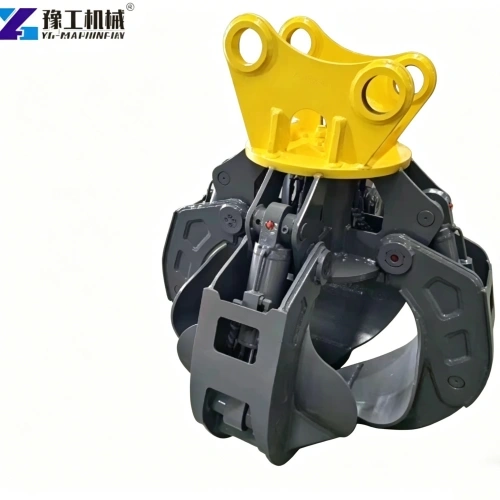
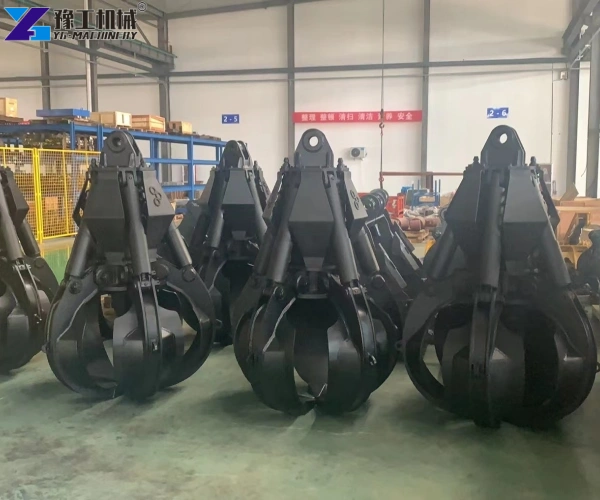
The orange peel grapple is a hydraulically driven excavator attachment. Named for its multiple radially arranged claws that, when closed, resemble a peeled orange, it’s a core component of excavators and mini excavators with claws. Through coordinated multi-claw gripping, it stably grabs, transports, and stacks lumpy, loose, and irregular materials without manual assistance, significantly improving material handling efficiency.
Compared to ordinary grapples, the orange peel grapple’s claws are more flexible and have a wider gripping range. The opening and closing angles can be adjusted flexibly according to the material size. It’s available in large heavy-duty and small models, with the small model suitable for 1.5-6 ton mini excavators (also known as a mini excavator grab), precisely suited for operations in confined spaces. Want to learn more? Contact us now.
Orange Peel Grapple Technical Parameter
| Item/Model | Unit | YGO04A | YGO06A | YGO08A | YGO06B | YGO08B |
| No. of Jaw | piece | 4/5 | 4/5 | 4/5 | 4/5 | 4/5 |
| Suitable Excavator | ton | 6-9 | 10-17 | 18-25 | 10-17 | 18-25 |
| Weight | kg | 355/420 | 900/1000 | 1650/1900 | 850/1000 | 1700/1950 |
| Max Open Jaw | mm | 1200 | 1600 | 2050 | 1900 | 2500 |
| Height of Opened Grapple | mm | 1000 | 1500 | 1700 | 1550 | 2000 |
| Working Pressure | bar | 200 | 260 | 320 | 260 | 320 |
| Working Flow | lpm | 50-100 | 60-120 | 200-250 | 60-120 | 200-250 |
| Capacity | m3 | 0.3 | 0.4 | 0.8 | 0.5 | 1 |
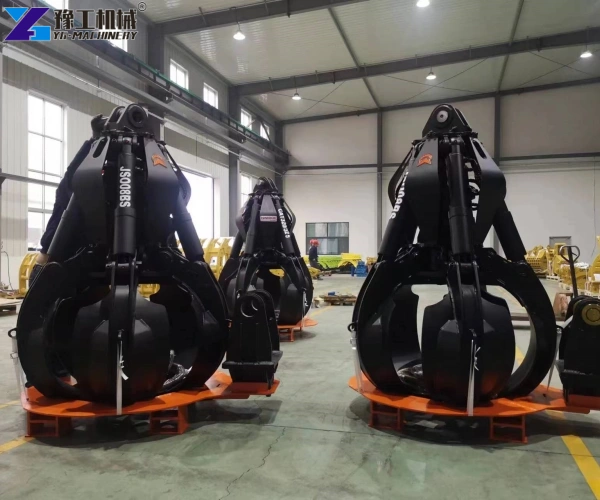
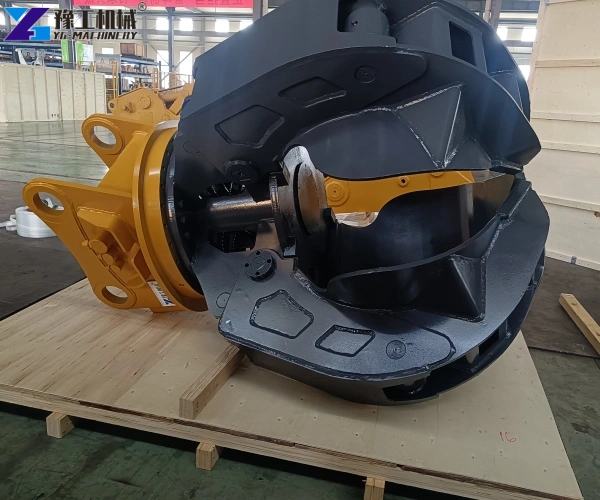
Key Features and Advantages of the Orange Peel Grapple
1. Stable Grabbing and High Adaptability
The multi-claw radial design allows for all-around material gripping with uniform force. Whether it’s lumpy ore, scrap steel, loose sand and gravel, or construction waste, it provides a stable grip without slipping. Compatible with excavators ranging from 1.5 to 40 tons, YG offers both small excavator grippers for mini-equipment and heavy-duty large models to suit different tonnage and application scenarios.
2. High Efficiency, Convenience, and Labor Saving
It replaces traditional manual gripping and handling methods, grabbing more than 10 times the amount of material per operation, significantly improving work efficiency. The operation is linked to the excavator, requiring no specialized operators; simple training is all it takes to learn how to use it. The small excavator gripper, in particular, is compact and flexible, allowing for quick material handling in confined spaces.
3. Robust and Durable, Easy Maintenance
The claws are made of high-strength wear-resistant steel and processed with a special heat treatment process, making them impact-resistant and wear-resistant. They can handle the gripping of hard materials for extended periods, extending their service life by 40% compared to ordinary grab buckets. The core components have a simple structure, and easily procurable wear parts result in low maintenance costs, meeting the high cost-performance requirements of the orange-skin grab bucket market.
4. Multifunctional and Versatile
It can perform various operations such as gripping, handling, stacking, and sorting without frequent attachment changes. Supporting 360° rotation (some models), it allows for precise control of the unloading position, adapting to various complex scenarios such as mines, ports, and waste recycling. Whether it’s bulk handling in large-scale projects or precise operations in small-scale projects, it can handle them flexibly.
5. Safe and Reliable, Reduced Risk
Fully hydraulically driven, the claws open and close smoothly, preventing material splashing. During operation, the operator can remotely control the machine from the excavator cab, eliminating the need for close contact with materials and reducing safety hazards such as falls from heights and material impact injuries. It is especially suitable for indoor and confined space operations of mini excavators with claws, offering superior safety.
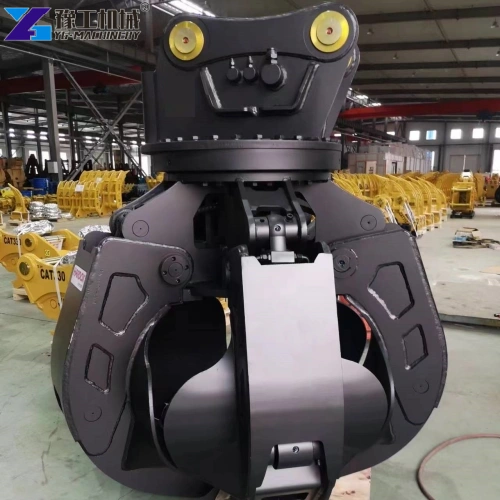
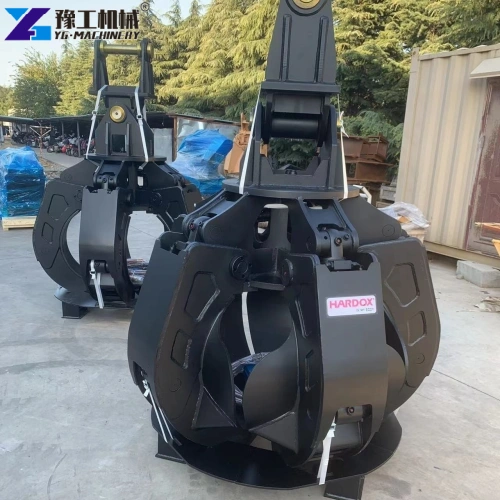
Application Scenarios and Fields of the Orange Peel Grapple
1. Mining Industry
It is used for grabbing and transporting materials such as ore, rock, and slag, replacing traditional manual labor and ordinary buckets, significantly improving the efficiency of material handling in mines, especially suitable for bulk material stacking and loading operations in open-pit mines.
2. Waste Recycling Industry
It is a core piece of equipment for recycling scrap steel, scrap iron, and construction waste. It is suitable for both bulk sorting in large recycling plants and precise handling in small recycling stations; the mini excavator claw (mini orange peel grab bucket) can be used for cleaning of indoor demolition waste, offering flexibility and convenience.
3. Port and Dock Industry
Used for grabbing and transporting bulk and lumpy materials such as coal, sand, and steel, enabling efficient ship loading and unloading and site stacking operations, solving the problem of easy spillage when grabbing bulk materials with ordinary buckets.
4. Municipal and Infrastructure Sector
Used in road construction, urban renewal, and river dredging projects, these mini excavators are used to transport construction waste, stones, silt, and other materials. Equipped with a claw, they can access narrow municipal construction areas and residential areas to clean and transfer materials without damaging the surrounding environment.
5. Landscaping and Agriculture Sector
Compatible with mini excavators equipped with claws, these machines are used to grab and transport trees, branches, straw, and other materials, assisting in landscaping, pruning, and farmland improvement. They replace manual labor, improving work efficiency and reducing labor intensity.
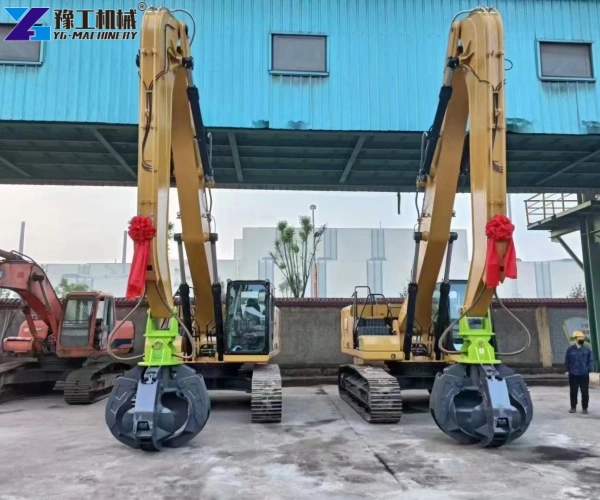
Orange Peel Grab: Common Problems and Solutions
As a professional manufacturer of orange peel grapples, YG produces a full range of models, including large heavy-duty models and smaller excavator grippers. Based on field experience, we have compiled the following five common problems and practical solutions:
1. Gripper opening and closing are not smooth or jams
The core cause is hydraulic line blockage, insufficient hydraulic oil, or rust on the pins at the gripper connection.
Solution: Check the excavator’s hydraulic system, clear any blockages, and replenish with hydraulic oil of the correct specifications; lubricate the pins, remove rust, and ensure smooth operation, especially for smaller excavator grippers, where the pin wear should be checked regularly.
2. Material slippage during gripping
This is mainly caused by insufficient clamping force, severe gripper wear, or excessively slippery material surfaces.
Solution: Check the hydraulic system pressure to ensure it reaches the equipment’s rated pressure; regularly check gripper wear and replace with wear-resistant grippers as needed; when gripping smooth materials, adjust the gripper opening angle appropriately to increase the clamping area.
3. Hydraulic Line Leaks and Abnormal Noises
This is often caused by loose pipe joints, aging seals, or insufficient hydraulic oil cleanliness. This is a common problem for all excavator attachments with claws.
Solution: Tighten pipe joints and replace aging seals; regularly change the hydraulic oil and clean the hydraulic filter to prevent impurities from entering the lines and extend the equipment’s lifespan.
4. Claw Flange Deformation and Damage
This is mainly caused by gripping materials exceeding the equipment’s rated weight or uneven force when gripping hard materials.
Solution: Strictly adhere to the equipment’s rated load capacity to avoid overloading; when gripping hard materials, adjust the claw flange angle to ensure even force distribution; if the claw flange is deformed, correct or replace it promptly, especially for small excavator claws, to prevent deformation from affecting operating accuracy.
5. 360° Rotation Function Malfunction
The core cause is a malfunctioning rotary motor or a blocked hydraulic circuit.
Solution: Stop operation, check the operating status of the rotary motor, and repair or replace it in time if damage is found; clean the hydraulic oil circuit to ensure smooth hydraulic oil flow, and perform regular lubrication and maintenance on the rotating mechanism.