

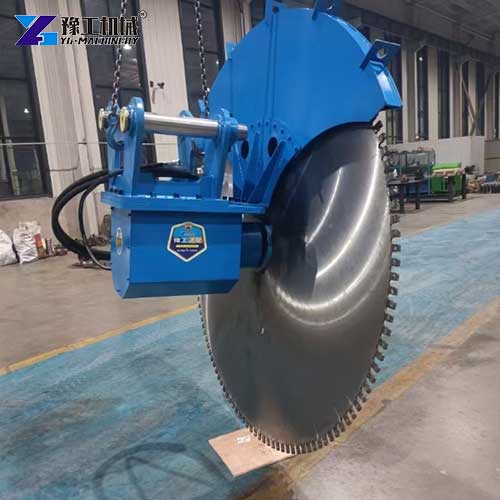
A small rock saw transforms a compact excavator into a precision cutting machine. It mounts to the excavator arm, spins a high-strength circular blade, and cuts through rock, concrete, and asphalt with controlled accuracy. No pounding. No blasting. Just a clean, straight cut that requires no secondary finishing. The YG series small rock saw offers four motor models covering excavators from 6 to 40 tons. Saw blades range from 800mm to 1800mm, with torque outputs from 600 to 3100 N.m and a 40 MPa peak pressure rating.
Small Rock Saw Technical Specifications:
| Model/Motor Model | YSJ04 | YGJ06 | YSJ08 | YSJ10 | ||||
| Rotation Mode | Fixed Type | 360°Rotation | Fixed Type | 360°Rotation | Fixed Type | 360°Rotation | Fixed Type | 360°Rotation |
| Applicable excavators (T) | 6-12 | 6-12 | 12-20 | 12-20 | 20-30 | 20-30 | 30-40 | 30-40 |
| Machine weight (KG) | 200 | 260 | 350 | 450 | 500 | 600 | 500 | 700 |
| Saw blade size (mm) | 800 | 1200 | 1600 | 1800 | ||||
| Theoretical Displacement (ml/r) | 154 | 154 | 493 | 792 | ||||
| Torque (N.m) | 600 | 600 | 1923 | 3100 | ||||
| Peak Pressure (MPa) | 40 | 40 | 40 | 40 | ||||
| Unit Torque (N.m/MPa) | 24 | 24 | 76.9 | 124 | ||||
| Continuous Speed (r/min) | 1-650 | 1-650 | 1-550 | 1-500 | ||||
| Maximum Speed (r/min) | 1100 | 1100 | 800 | 600 | ||||

Where a Small Rock Saw Works Best?
The YG series excavator rock saw serves multiple industries with specific cutting needs.
- Hard Rock Quarrying and Mining. Granite and basalt cutting for block extraction and dimensional stone. The YSJ08 and YSJ10 with higher torque cut clean blocks with minimal waste—unlike blasting, which fractures the stone internally.
- Reinforced Concrete Demolition. Cutting through structural concrete and rebar in one pass. Essential for removing sections of buildings while keeping adjacent areas intact. Hospitals and occupied buildings often require this level of control.
- Trenching and Utility Installation. Cutting narrow, precise trenches through rock for utilities and pipelines. The smaller models (YSJ04, YGJ06) work well in urban spaces where damage to surrounding surfaces must be avoided.
- Road and Highway Construction. Clean, straight cuts through asphalt and concrete for repairs, expansion joints, and utility access. Low vibration is critical on bridge decks where impact tools would stress the structure.
- Foundation and Basement Excavation. Removing rock layers cleanly for foundation placement. Precision control allows the operator to work within centimeters of existing foundations.
- Urban Demolition. Low noise and minimal vibration allow work in hospitals, residential areas, and near sensitive equipment. The excavator rock saw produces less dust than breakers, reducing environmental compliance requirements.


800mm to 1800mm Blades: Cutting Depth and Application Fit
Blade size determines cutting depth. The relationship is not one-to-one—cutting depth is approximately 40-45% of blade diameter—but larger blades cut deeper.
| Motor Model | Blade Size | Approx. Cutting Depth | Suitable Excavator | Best For |
| YSJ04 | 800mm | 300-350mm | 6-12T | Light rock, concrete, asphalt |
| YGJ06 | 1200mm | 500-550mm | 12-20T | Medium rock, road cutting |
| YSJ08 | 1600mm | 700-750mm | 20-30T | Hard rock, reinforced concrete |
| YSJ10 | 1800mm | 800-850mm | 30-40T | Granite, basalt, massive structures |
800mm blades suit shallow trenches, sidewalk cutting, and light demolition. The YSJ04 at 200kg is easy to maneuver and fits smaller excavators.
1200mm blades handle deeper trenches, building foundations, and medium-scale quarry work. The YGJ06 weighs 350kg in fixed configuration and 450kg with 360° rotation—still manageable on a 12-20 ton machine.
1600mm blades and above are for heavy work. The YSJ08 excavator concrete saw weighs 500- 600 kg. The YSJ10 weighs 500- 700 kg. These models require larger excavators but deliver the cutting depth and torque for granite, basalt, and thick reinforced concrete.
Blade selection is material-specific. Diamond blades excel at cutting reinforced concrete, granite, and basalt. Carbide-tipped blades perform better in limestone, sandstone, and similar formations. The operator selects the blade based on the material—not just the blade size.


How Does a Small Rock Saw Work on Site?
Using a small rock saw is straightforward. One operator, one excavator, one attachment—no extra crew needed.
- Positioning. The operator drives the excavator to the cut line and positions the blade over the mark. The arm lowers the blade to the surface at the correct angle.
- Cutting. The operator engages the hydraulic flow. The blade spins up to speed and begins cutting into the material. The operator controls the descent rate—slow and steady for hard rock, faster for concrete and asphalt. The blade’s diamond segments grind through the material, cutting a straight, clean line. The machine handles the work; the operator manages the pace.
- Depth control. The operator monitors the cut depth and lowers the blade incrementally to reach the required depth in a single pass. Multiple passes are possible for deeper cuts, but the YG series excavator concrete saw is designed to achieve full depth in one pass for most applications.
- Completion. At the target depth, the operator lifts the blade, swings the arm clear, and moves to the next cut. The cut edge is smooth, straight, and requires no secondary finishing.
- No extra steps. No cleanup of jagged edges. No re-breaking. And no hauling away oversized chunks. One pass, one finished cut.
The time difference: A breaker takes 1.5 to 2 times longer per cut when factoring in finishing work. The rock saw machine cuts and finishes in the same pass. For a full shift, this time difference adds up to hours—more cuts per day, faster project completion, lower labor costs.
Small Rock Saw For Sale
If you need a compact precision rock saw machine for your excavator, contact us today. Tell us your excavator make and model, tonnage, auxiliary hydraulic specifications, required maximum cutting depth and the primary materials you cut, and we will recommend the most suitable model and blade configuration along with a detailed factory-direct quotation.