
Asphalt and concrete pavements frequently suffer cracks, which crack filling machines target to repair. Affected by temperature changes, vehicle loads, rainwater infiltration, and freeze-thaw cycles, tiny cracks can rapidly expand into network cracks, potholes, and roadbed settlement, significantly shortening road lifespan and increasing subsequent major repair costs. Crack filling machines, as the core specialized equipment for crack sealing and repair, directly determine the density of the sealant, the waterproofing effect, and the construction efficiency. YG crack-filling machines are favored by customers both domestically and internationally due to their stable temperature control, anti-clogging durability, low failure rate, and high cost-effectiveness. If you are also interested in crack filling machines, contact us immediately!
YG Crack Filling Machine Models and Specifications
| Model | YG-50L | YG-80L | YG-100L |
| Hopper volume | 50L | 80L | 100L |
| Discharge method | Self flow | Asphalt pump feed | Asphalt pump feed + hand-held tube |
| Heating method | Liquefied gas | Liquefied gas + heat transfer oil | Italian diesel burner, heat transfer oil cycle heating |
| Temperature control | Temperature sensor 180 ° (temperature control call) | Temperature sensor 180 ° (temperature control call) | Automatic temperature control system |
| Filling speed | 10m/min | 15m/min | 20m/min |
| Length of sealing pipe | —— | —— | 5m |
| Walking mode | Push-type + brake device | Push-type + brake device | Push-type + trailer |
| Mixing method | Manual mixing | Manual mixing | Electric stirring |
| Power Configuration | Solar panels + batteries | Solar panels + batteries | Import 2KW generator |
| Dimensions | 1200*700*1200mm | 1200*700*1200mm | 1750*786*1200mm |
| Weight | 120kg | 150kg | 220kg |

Main Structural Components of a Crack Filling Machine
- Material Hopper/Melting Box: The core component, used to load and heat solid block sealant (some models can also load liquid sealant). It is usually made of heat-resistant and corrosion-resistant materials (such as stainless steel).
- Heating System: Typically uses a diesel burner, gas burner, or electric heating element to provide precisely controllable heat to melt the sealant into a flowable state (operating temperature is usually around 180°C – 200°C).
- Insulation Layer: Encased outside the hopper, it reduces heat loss, improves thermal efficiency, and maintains a stable sealant temperature.
- Mixing System: The hopper typically contains a mixing paddle to ensure even heating of the sealant and prevent localized overheating, scorching, or sedimentation at the bottom.
- Temperature Control System: A sophisticated temperature control device (such as a thermostat or thermocouple) monitors and adjusts the sealant temperature within the hopper in real time, ensuring it reaches the optimal application viscosity.
- Pumping System: Transports the molten sealant from the hopper to the injection gun/nozzle. Common types include gear pumps, piston pumps, or screw pumps.
- Injection System: Includes the injection hose and injection gun (or nozzle). Operators precisely inject the sealant into the cracks by controlling the injection gun’s switch. Some advanced models are equipped with an automatic crack-tracking injection system.
- Power System: Provides the power required for equipment operation, typically using a diesel engine or electric motor.
- Control Panel/Control System: Centralized control of heating temperature, pumping speed, and movement (if self-propelled).
- Walking System: Hand-push type: Small equipment, manually pushed, suitable for small-area repairs or narrow areas.Self-propelled type: Self-powered walking device (wheeled or tracked), easy to move, highly efficient, suitable for large-area operations.Trailer type: Towed by a tractor (such as a truck or tractor).
Hand-push vs. Towed Crack Filling Machines
1. Movement and Load-bearing Method
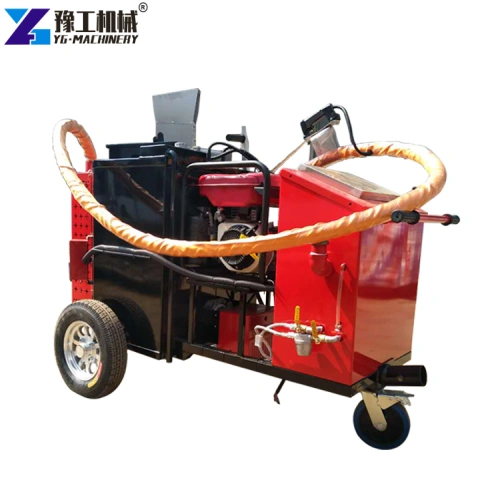
Hand-push Crack Filling Machine: Relies on manual pushing; the machine frame is equipped with anti-slip handles and swivel wheels; no trailer chassis; compact and lightweight overall structure; common capacities are 60L and 100L.
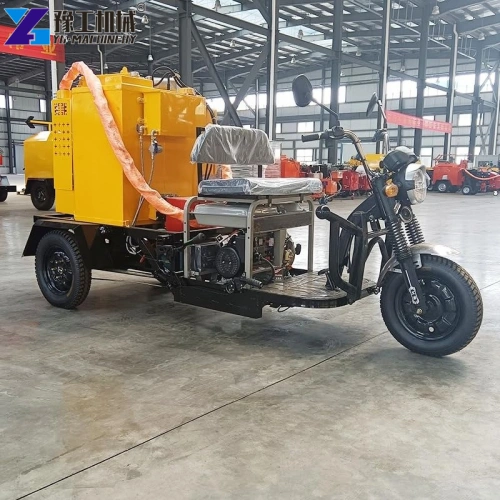
Towed Crack Filling Machine: Equipped with an independent trailer frame, shock-absorbing chassis, and safety braking device; requires a pickup truck or tricycle to tow; capacity is mostly 350L and above; heavy-duty body; large capacity for melt filling.
2. Power and Heating Configuration
Hand-push Crack Filler: Mainstream LPG heating, high-end configuration supports both LPG and diesel dual fuels; generator power is relatively small, suitable for short-term single-person operation.
Towed Crack Filler: Standard configuration includes a high-power diesel thermal oil heating system, paired with a high-horsepower diesel generator set, ensuring stable heat output and sufficient heat supply for long-term continuous operation, eliminating the need for frequent refueling during long-distance field construction.
3. Construction Output Efficiency
Hand-push Crack Filler 100L: This model fills 300-500 meters of cracks per hour, with limited melt capacity, requiring refilling every few hours.
Towed Crack Filler 350L: This model can complete 600-900 meters of crack filling per hour; the large-capacity vessel supports continuous 24-hour construction, significantly reducing the frequency of refilling.
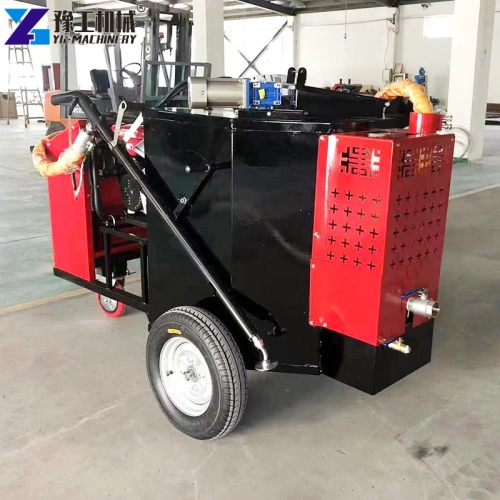
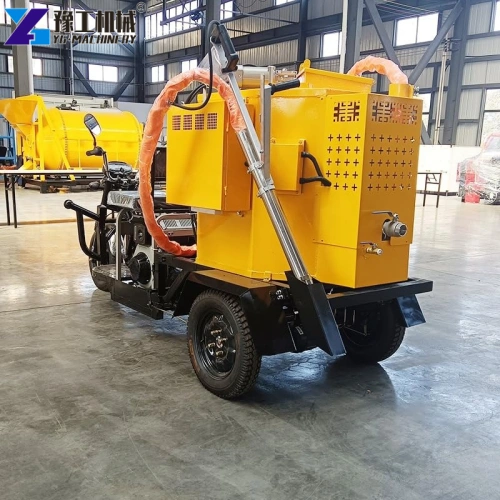
Hand-Push vs. Traction-Type Crack Filling Machine: Comparison of Working Conditions
Hand-Push Type Applicable Scenarios:
- Narrow areas such as city streets, residential roads, parking lots, and sidewalks where large vehicles cannot enter;
- Minor repairs and small-scale maintenance projects, with a monthly crack sealing length of less than 10,000 meters;
- Municipal emergency repairs, industrial park flooring, and expansion joint repairs in small factories;
- Small construction teams with limited budgets, township sanitation departments, and property maintenance units.
- Advantages: Flexible transportation; can be directly loaded into trucks and pickup truck beds without the need for hoisting equipment; can be operated independently by one person, resulting in low labor costs; lower procurement and maintenance prices.
- Disadvantages: Weak range; low efficiency for continuous construction on long-distance national highways and expressways; slow payback period for very large projects.
Towable Crack Applicable Scenarios:
- Maintenance of long-distance, continuous cracks in urban roads and mining areas;
- Road and bridge engineering, large-scale highway EPC projects, with monthly work exceeding 10,000 meters;
- Outdoor sites with few resupply points, such as suburbs and mining areas;
- Professional large-scale maintenance companies, highway bureaus, and overseas long-distance road projects (such as Australian mining areas and European trunk roads).
- Advantages: Large capacity and long endurance, strong stability during continuous operation, lower material consumption per unit of construction, and higher overall returns for large-scale projects; can be equipped with a hot air crack cleaning integrated machine to achieve integrated construction of grooving, crack cleaning, and grouting.
- Disadvantages: Large size, large turning radius, unable to pass through narrow sections of road; requires a towing vehicle and at least two operators; higher investment in equipment procurement and transportation.
Choose YG For Peace Of Mind
For small-scale, narrow-site, and short-distance repairs, choose the push-type; for long-distance, large-volume, and outdoor trunk line projects, prioritize the towable type. YG can provide customized equipment matching solutions based on the client’s project scale, construction location, climate, and transportation conditions, balancing construction efficiency and investment costs. Contact us now!