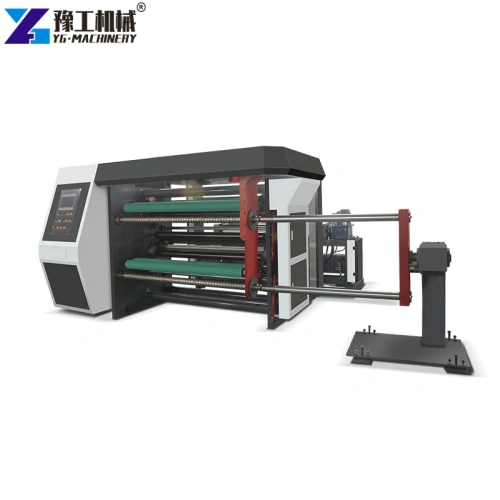
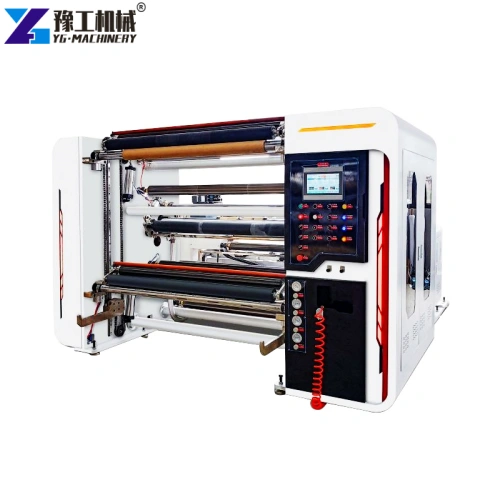
In the processing and production of roll materials such as film, paper, non-woven fabric, aluminum foil, and tape, roll slitters are core equipment that determine the precision, yield, and production efficiency of finished products. Many companies experience problems such as burrs, misalignment, insufficient speed, material stretching and deformation, and oversized equipment. These issues are not due to equipment quality problems, but rather to a mismatch between the machine model and the production conditions. Correct slitting machine selection hinges on three key factors: the characteristics of the processed material, the effective slitting width, and the required production speed.
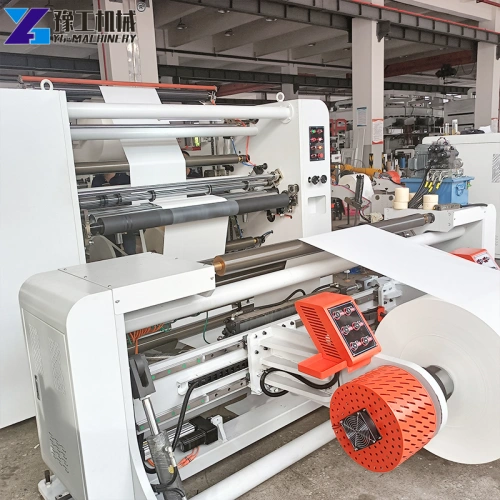
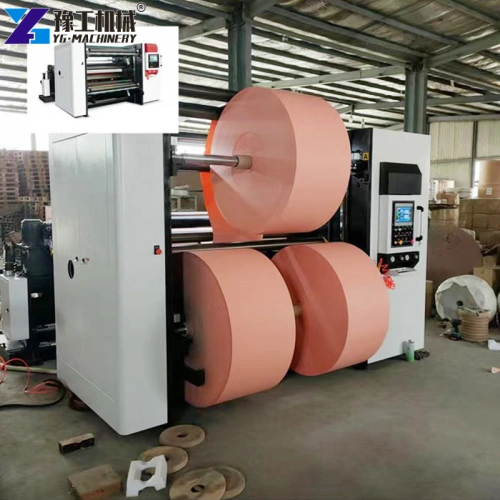
YG Roll Slitter Parameter
| Model | YG- 1300 | YG- 1600 | YG- 1800 |
| Max width | 1300mm | 1600mm | 1800mm |
| Max Diameter for unwinding | ¢1400mm | ¢1400mm | ¢1400mm |
| Min width of slitting | 30mm | 30mm | 30mm |
| Max Diameter of rewinding | ¢1000mm | ¢1000mm | ¢1000mm |
| Speed | ≤350m/min | ≤350m/min | ≤350m/min |
| Total Power | 24kw | 26kw | 30kw |
| Power supply | 380V/50hz | 380V/50hz | 380V/50hz |
| Weight | 4000kg | 4500kg | 5500kg |
| Overall dimension(LxWxH) | 3300x3150x1930(mm) | 3300x3450x1930(mm) | 3300x3650x1930(mm) |
Selecting Based on Material Characteristics
Material is the primary factor in selecting a roll slitter. The differences in toughness, thickness, hardness, and ductility of different materials directly determine the machine’s frame rigidity, slitting method, tension control system, and blade type.
- For thin, soft materials such as films, PET, PE, non-woven fabrics, and paper, which are highly ductile, easily stretched, and prone to wrinkling, a surface-curling roll slitter with a high-precision constant tension control system and pneumatic or circular blade shallow-cutting modes is required. The equipment must support low-speed stable cutting and fine-tuning of tension to prevent material stretching, deformation, edge curling, and uneven thickness, making it suitable for packaging, printing, and daily necessities roll material processing scenarios.
- For hard, high-toughness materials such as aluminum foil, copper foil, fiberglass, tape, and thick films, which are hard, difficult to cut, and prone to burrs, a vertical high-speed roll slitter is required, equipped with carbide circular blades and upper and lower cutting blade assemblies. The frame should use a thickened steel structure to eliminate vibration during high-speed operation. Simultaneously, an anti-scratch conveyor structure is required to ensure a smooth, burr-free cut surface, meeting the high-precision processing requirements of electronic materials and industrial auxiliary materials.
Furthermore, special materials such as breathable membranes, foam, and composite rolls require customized anti-static, anti-pressure-damage, and low-tension roll slitters. Ordinary general-purpose roll slitters are completely incompatible, easily leading to batch scrap.
Selecting a Roll Slitter Based on Cutting Width
The cutting width directly corresponds to the machine’s specifications, roller length, and operational stability, making it a fundamental parameter for selection. Many companies fall into the misconception that “wide machines are suitable for all narrow materials,” leading to resource waste and cutting accuracy deviations.
The core principle of industry selection: the width of the raw material determines the maximum width the equipment can handle, while the narrowness of the finished product determines the equipment’s precision configuration. Conventional small narrow-width roll slitters are suitable for raw materials up to 1000mm in width, ideal for small-batch, multi-specification, and narrow-strip slitting. These machines have a small footprint, are easy to debug, and offer high cost-effectiveness, making them suitable for small and medium-sized processing plants.
Medium and large-width roll slitters are suitable for raw materials of 1300mm, 1600mm, 1800mm, and above. They feature stronger machine rigidity and higher roller concentricity, enabling full-roll slitting of large-format rolls and simultaneous multi-blade slitting operations. It’s important to note that wide-width slitting machines are unsuitable for long-term processing of narrow, small materials. The large machine span and even slight vibrations can cause narrow material slitting misalignment and excessive dimensional errors. Conversely, small machines cannot handle large rolls of material, easily leading to roller bending and overload malfunctions.
Furthermore, the minimum slitting width of the finished product determines the precision configuration of the blade assembly. Precision narrow-width slitting requires a high-precision micro-adjustment blade holder to ensure millimeter-level slitting error, suitable for high-end precision roll material production.
Selecting a Roll Slitter Based on Production Speed
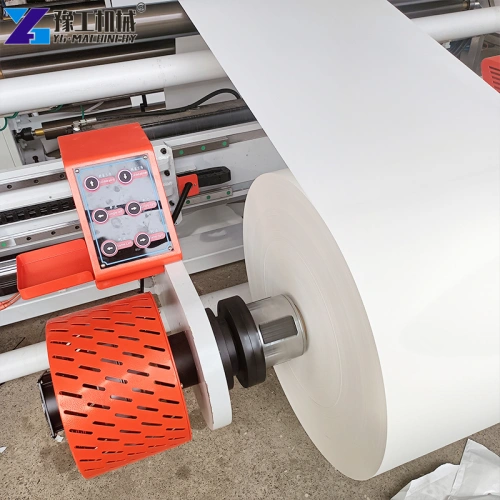
Slitting speed directly impacts production line capacity. It is available in three speed ranges: standard economy, medium-speed mass production, and high-speed precision, catering to different production needs.
- The standard low-speed economy roll slitter, with a speed range of 0-120 m/min, features a simple structure and low maintenance costs. Suitable for small-batch processing, sample cutting, and factories with scattered orders, it fully meets small-capacity requirements and offers excellent cost-effectiveness.
- The medium-speed mass production roll slitter, with a speed range of 120-280 m/min, is equipped with a fully automatic tension control system, automatic deviation correction, and automatic meter counting. Suitable for routine mass production in factories, it balances speed and precision, making it the mainstream choice for small and medium-sized mass production enterprises and perfectly matching the production line rhythm.
- The high-speed precision roll slitter, with speeds exceeding 300 m/min, features servo-independent drive, closed-loop tension control, and an intelligent deviation correction system. The machine body undergoes precision aging treatment, ensuring vibration-free and deviation-free high-speed operation. Suitable for large factories processing large batches of high-standard roll materials, it effectively improves production efficiency and reduces per-roll processing costs.
Important Reminder: High-speed slitting should not be used indiscriminately for soft, thin materials, as it can easily cause stretching, wrinkling, and misalignment. High-speed slitting of hard, thick materials requires a high-end blade assembly and a stable frame; otherwise, blade breakage and cut surface damage may occur.
Summary
The core elements for selecting a roll slitter are: for soft materials, consider tension; for hard materials, consider the blade assembly; for wide materials, consider the machine body; for mass production, consider speed; and for precision, consider the configuration. For small-batch, narrow-width soft materials, choose an economical, low-speed model; for regular mass production of roll materials, choose a medium-speed standard model; and for high-end precision and large-volume processing, choose a high-speed servo precision model. This avoids problems such as poor accuracy, low capacity, high failure rate, and equipment idleness from the outset.
A high-quality roll slitter is not necessarily one with the highest possible parameters, but rather one that is precisely adapted to the materials being processed, the width specifications, and the capacity requirements. If you need a customized roll slitter selection plan based on product parameters and production scenarios, please feel free to contact us for professional one-on-one equipment matching and capacity optimization advice.