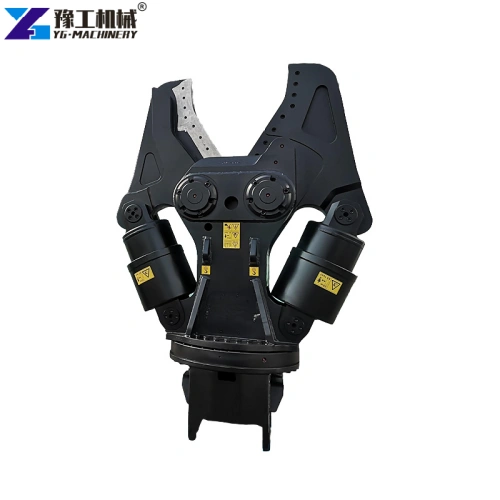
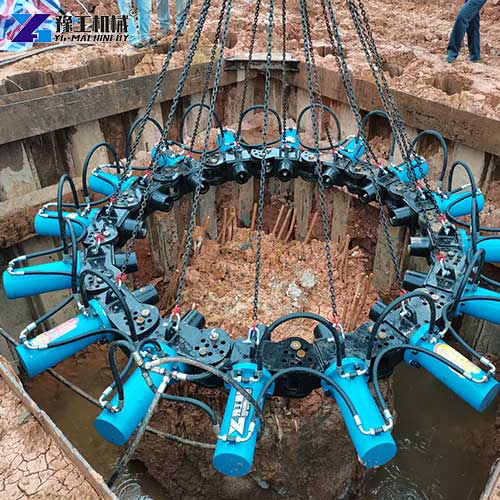

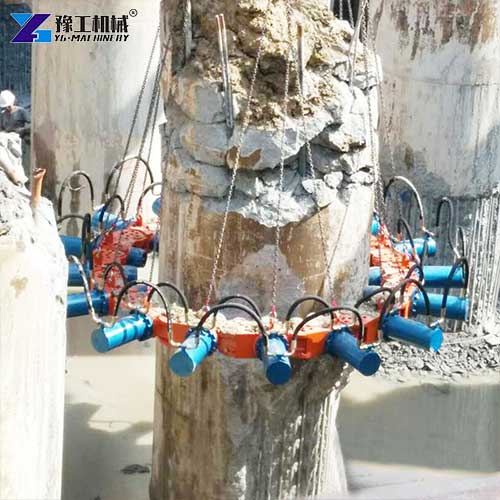
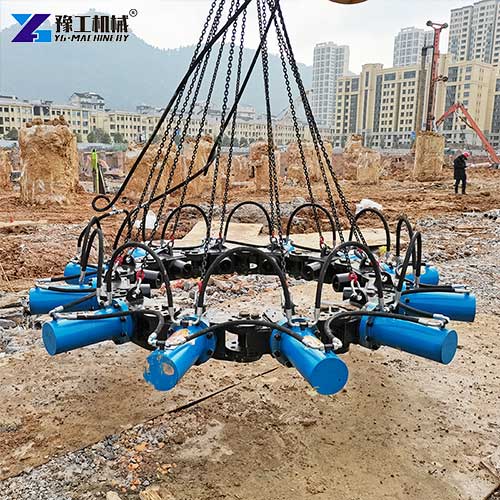
Pile breaking is one of the most repetitive and physically demanding tasks in foundation construction. Traditional methods—jackhammers, hand-held breakers, and pneumatic tools—are slow, labor-intensive, and dangerous. Workers stand over the pile head, swinging heavy tools in awkward positions. The risk of injury is high, and the quality of the break is inconsistent. A hydraulic pile breaker changes this. It mounts to an excavator or lifting equipment, clamps onto the pile head, and fractures the concrete through static hydraulic pressure. No impact, no vibration, and no manual labor. One operator controls the entire process from a safe distance.
Hydraulic Pile Breaker Technical Specifications:
| Module Number | PCS | 4 | 8 | 9 | 10 | 11 | 12 | 13 | 14 | 15 | 16 | 17 | 18 |
| Single-module weight | KG | 1600 | 2640 | 2970 | 3300 | 3630 | 3960 | 4290 | 4620 | 4950 | 5280 | 5610 | 5940 |
| Pile diameter range | mm | 400-600 | 600-800 | 800-1000 | 1000-1150 | 1150-1300 | 1300-1500 | 1500-1650 | 1650-1800 | 1800-1970 | 1970-2200 | 2200-2360 | 2360-2500 |
| Hydraulic excavator | T | 20T-30T | 30T-40T | Hydraulic system/pump station | |||||||||
| Max.Thrust | 300KN | Max.Cylinder required | 20L/min | Machinery Tonnage | ≥20T | Location pinΦ35 | |||||||
| Max.Cylinder Trip | 300mm | Chisel diameter | 110mm | Single-module weight | 335KG | ||||||||
| Max.Cylinder Pressure | 300MPa | Max.Hoist Capacity | ≤500mm | Single-module size | A combination of the total weight | ||||||||

3 Different Types of Hydraulic Pile Breakers
Each format of this hydraulic pile breaker shares the same core module connection standard, so core components remain interchangeable across different setups.
Round pile breaker: The most widely used main configuration, with a fully modular design that flexibly adapts to different pile diameters. It delivers high breaking efficiency and fits all types of general foundation construction scenarios, making it the standard choice for most pile group projects.
Square pile breaker: Developed exclusively for concrete square piles, it delivers stable clamping without slipping during operation. It creates flat, even breaking surfaces with no dead corners, and is the standard matching equipment for precast square pile construction.
Claw-type pile breaker: Also known as the compact “transformer” style, it is designed specifically for narrow spaces, micro piles and foundation renovation projects. Its compact, flexible structure works in restricted working areas where full-size circular units cannot fit, making it ideal for limited-space construction sites.
Power & Lifting Equipment Compatibility Options
This pile head breaking machine supports multiple power and lifting combinations to fit varied site resource conditions, with no need for dedicated custom supporting equipment.
Excavator direct drive: For small to medium pile sizes (13 modules and below), the excavator’s own hydraulic system provides both driving power and lifting force. This setup requires no extra power equipment, making it highly convenient for scattered small projects and sites with limited supporting facilities.
Independent hydraulic station + crane: For large diameter piles and high-strength concrete, an independent hydraulic power station (available in 15KW, 22KW and 30KW ratings) provides stable high-pressure output, while a crane handles lifting work. This setup delivers consistent breaking force for large pile group projects and high-grade bridge foundation piles.
Hydraulic station + loader: For sites with loader fleets but no crane access, the loader can provide lifting support paired with an independent hydraulic station. This configuration makes full use of existing on-site equipment to reduce additional rental costs.
All connection interfaces follow universal industry standards, so the concrete pile cutting machine pairs with most mainstream excavator, crane and loader models without custom modification.

The Problem with Traditional Pile Breaking Methods
Traditional pile breaking relies on impact tools. Jackhammers, pneumatic breakers, and hand-held chisels hammer away at the concrete until it fractures. This approach creates several problems that contractors have simply accepted.
- Problem 1: Inconsistent break quality. Impact tools depend on the operator’s skill and fatigue level. Some sections of the pile head get over-broken. Others are under-broken. The result is an uneven surface that requires additional finishing.
- Problem 2: Safety hazards. Workers stand over the pile head while swinging heavy tools. The risk of injury—from flying concrete fragments, tool kickback, or falls—is high. Confined spaces and deep excavation sites add to the danger.
- Problem 3: Noise and vibration. Impact tools generate high noise levels and transmit vibration through the pile. This affects nearby structures and creates complaints in urban environments. Workers face long-term hearing damage risk.
- Problem 4: Low efficiency. Jackhammers break small sections at a time. A single pile head can take an hour or more to break. For bridge foundations with dozens or hundreds of piles, the total time is significant.
A hydraulic pile breaker solves all these problems:
- Consistent break quality. All cylinders fire simultaneously, creating a uniform fracture line.
- Operator safety. The operator controls the pile head breaking machine from a distance. No one stands over the pile head.
- Low noise and vibration. Static hydraulic pressure breaks the concrete. No impact, no noise, no vibration.
- High efficiency. The pile breaking machine breaks the entire pile head in a single operation—typically 2-5 minutes per pile.
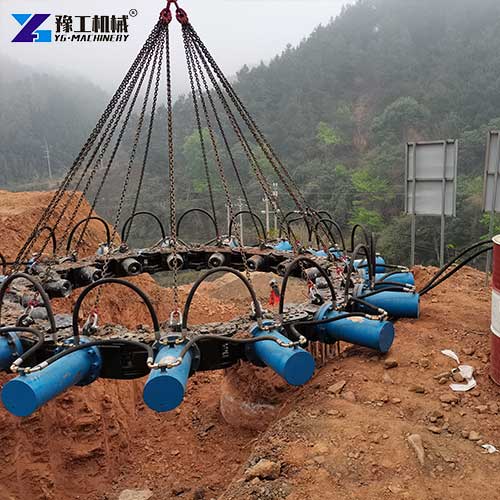

How the Hydraulic Pile Breaker Works in Practice?
The operation of a hydraulic pile breaker is straightforward and efficient.
- Step 1: Position the machine. The excavator or lifting equipment positions the module ring over the pile head. The ring is lowered until it sits at the break line.
- Step 2: Engage the chisels. The operator activates the hydraulic system. Pressurized fluid flows to each cylinder, driving the chisels into the pile. The force is applied radially—from all sides simultaneously—fracturing the concrete.
- Step 3: Fracture and remove. The concrete breaks along the fracture line. The broken pieces fall away from the pile. The operator lifts the module ring away, leaving a clean, flat pile surface.
- Step 4: Repeat. The machine moves to the next pile. The entire operation takes 2-5 minutes per pile, depending on the concrete strength and pile diameter.
The hydraulic system requirement: The YG series pile breaking machine requires 20 L/min of hydraulic flow at 300 MPa. The maximum thrust is 300KN. The maximum cylinder stroke is 300mm. The chisel diameter is 110mm.


If you are sourcing a reliable concrete pile cutting machine for your foundation projects, or need professional configuration advice for specific pile group works, reach out to our team today. We will provide detailed specification sheets and targeted selection guidance to help you find the ideal pile breaking machine for your construction needs.