

Crawler Dredging Robot performance is not unlimited. Most operational failures do not result from poor machine quality. They happen because the site conditions exceed the machine’s physical boundaries. When a tracked robot sinks into deep sludge, wraps its cutter head in a discarded fishing net, or gets pushed off course by fast-flowing water, the project stops. Understanding these three physical boundaries before you deploy is the difference between a smooth operation and a recovery mission. This article breaks down the three most common “stuck” scenarios and what you should confirm before starting your project. If your site has any of these risk factors, send us your site video or photos, and our engineers will assess whether a standard model is suitable.
TL;DR: Underwater dredging robot fails on site for three main reasons: insufficient ground pressure in ultra-soft sludge (sinking), cutter head entanglement from debris like fishing nets or rebar (stalling), and hydrodynamic forces from fast currents (drifting). As a result, checking your site’s sediment bearing capacity, debris profile, and water velocity before deployment prevents costly recovery operations.
| Model | YG-500 | YG-600 | YG-700 | YG-800 | YG-900 | YG-1200 |
| Robot dimensions | 1500*500*650mm | 1500*600*650mm | 1600*700*650mm | 1600*850*700mm | 1650*960*750mm | 1900*1200*750mm |
| Dredging width | 500mm | 600mm | 700mm | 800mm | 900mm | 1200mm |
| Track travel speed | 3-15m/s | 3-15m/s | 3-15m/s | 3-15m/s | 3-15m/s | 3-15m/s |
| Robot weight | 320kg | 350kg | 380kg | 400kg | 420kg | 500kg |
| Pump output diameter | 3inch | 3inch | 4inch | 4inch | 4inch | 4inch |
| Pump flow rate(cubic meters/ hour) | 100 m³ | 100m³ | 200m³ | 200m³ | 200m³ | 200m³ |
| Pump head | 0-30m | 0-30m | 0-30m | 0-30m | 0-30m | 0-25m |
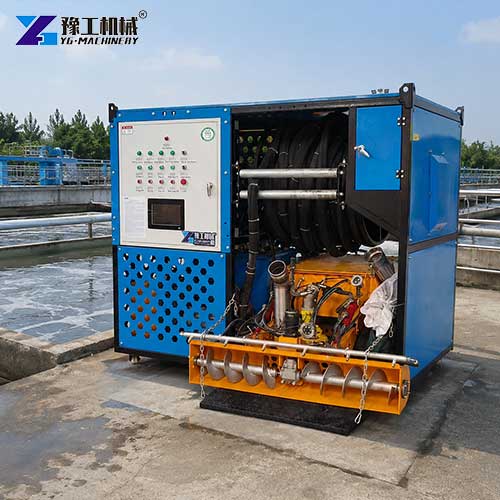
| Hydraulic station dimensions(mm) | 2200*1200*1700 | 2200*1200*1700 | 2200*1200*1700 | 2200*1200*1700 | 2200*1200*1700 | 2120*1240*1200 |
| Main motor power | 22kw | 22kw | 30kw | 30kw | 30kw | 45kw |
| Hydraulic system pressure | 0-16Mpa | |||||
| Particle size | 15mm | 15mm | 38mm | 38mm | 38mm | 60mm |
| Reeling system speed | 0-10r/min | |||||
| Hydraulic hoses | 50m (Standard configuration) | |||||
| Control system | Wireless remote control | |||||
| Lighting system | Underwater LED lights *2 | |||||
Boundary 1: Ultra-Soft Sludge and Track Sinking
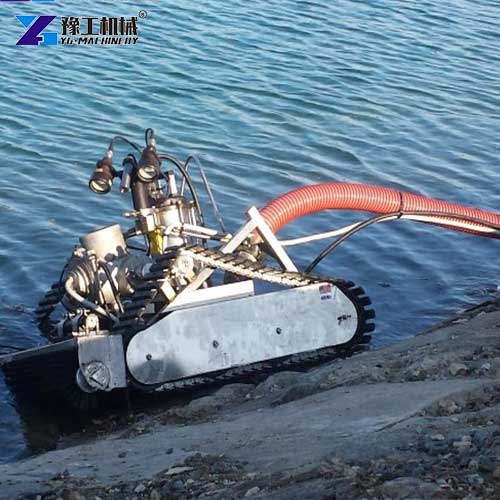
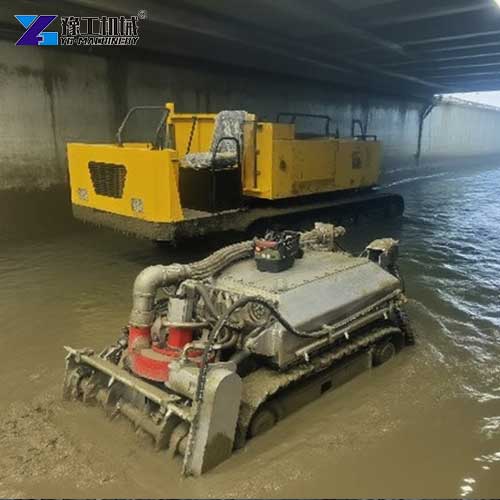
The most common physical limit is ground bearing capacity. A crawler dredging robot relies on its tracks to distribute weight. However, in extremely soft sludge or newly deposited silt, the ground cannot support the machine.
- The failure mode: Industry research shows that tracked robots operating in soft underwater environments cause the soil to compress and deform, leading to sinking or even burial. If one track loses support on uneven ground, the machine may tilt or become trapped.
- What to check: Ask what the sediment’s bearing capacity is. If the sludge is too soft to walk on, you may need a model with a wider track design or a different locomotion method.
- How we mitigate it: Our chassis design distributes weight across the track length. For projects with extremely soft bottoms, our engineers review the site conditions and may recommend specific track configurations to reduce ground pressure and prevent sinking.
Boundary 2: Cutter Head Entanglement (Fishing Nets and Rebar)
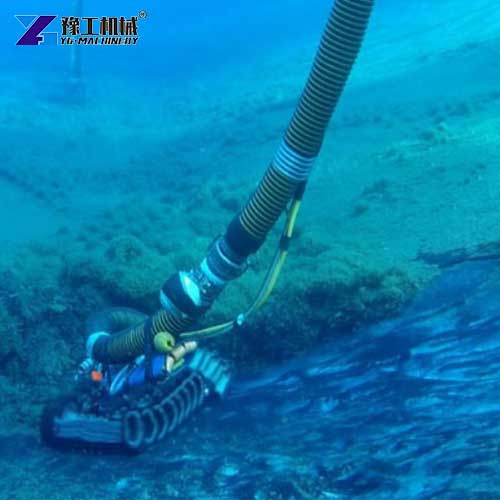
The second boundary is debris entanglement. An underwater dredging robot relies on a rotating cutter head to loosen sediment. When that head hits long, flexible, or high-tensile debris, the machine stalls.
- The failure mode: Field experience shows that discarded fishing nets, steel wire ropes, and construction rebar are among the most common causes of cutter head failure. A net can wrap around the shaft and stall the motor; rebar can bend or break cutting teeth.
- What to check: Inspect the site for visible debris. If the water body receives urban runoff or has a history of illegal dumping, entanglement risk is high.
- How we mitigate it: Our cutter head design includes a sealed bearing housing and a specific blade profile that resists wrapping. For sites with known high entanglement risk, we can recommend models with reinforced cutting structures and provide operating procedures to clear jams safely.
Boundary 3: High Water Velocity and Positional Instability
The third boundary is hydrodynamic force. A crawler dredging robot works best in still or slow-moving water. However, fast currents compromise stability.
- The failure mode: Academic studies on underwater tracked vehicles indicate that current velocities around 1.5 m/s can exert enough force to disturb operations and affect positioning. The robot may be pushed sideways, lose traction, or struggle to maintain its heading.
- What to check: Measure or estimate the water flow velocity at the working depth. If the site is in a tidal channel, near a lock, or downstream of a discharge point, velocity may exceed the robot’s design limit.
- How we mitigate it: Our control system allows operators to adjust track speed and torque to counteract minor currents. For sites with consistently higher flows, we advise scheduling work during low-flow windows or using anchoring methods. Our technical team can review your flow data and confirm if the machine can operate safely.
What to Confirm Before Deployment
Before you deploy an industrial tank cleaning robot or a river dredging unit, confirm these three site parameters. These are the same inputs our engineers need to recommend the correct configuration:
- Sediment bearing capacity: Is the bottom firm enough to support tracked movement, or is it deep, unconsolidated sludge?
- Debris profile: Are there fishing nets, steel cables, or construction waste present?
- Water velocity: What is the typical and maximum flow speed at the working depth?
If you cannot answer these questions, send us a short site video or describe the conditions. Our team will assess the risk and confirm whether the standard machine is suitable.
Customer FAQ About Crawler Dredging Robot Operational Limits
A: If the sludge is extremely soft, the tracks may sink and lose traction. The machine is not designed for unlimited soft-ground operation. We recommend confirming the sediment bearing capacity before deployment. If the site is too soft, our engineers can suggest alternative configurations or operating methods.
A: Stop the machine immediately to prevent motor overload. Do not attempt to reverse the cutter while it is jammed, as this may tighten the wrap. Our operating manual provides a step-by-step procedure for clearing entanglements safely. For sites with high net debris, we can recommend a model with a reinforced cutter head and provide additional protective measures.
A: High flow velocity creates hydrodynamic forces that can push the machine off course or reduce track traction. Industry studies indicate that velocities around 1.5 m/s can begin to affect stability. If your site has high flow, schedule work during low-current periods and consult our engineers for anchoring recommendations.
A: The machine can handle both, but the risk profile changes. Soft riverbeds carry a sinking risk; hard industrial tanks may contain abrasive debris that increases cutter wear. For industrial tank cleaning robot applications, confirm the debris type and hardness before selecting the cutter head.
A: Provide the sediment type (soft sludge, sand, gravel), the presence of debris (nets, rebar, plastic), and the water flow velocity. If possible, send a short video of the site. Our engineers will review and confirm whether the standard model is suitable or if a customized configuration is needed.
Factory Support & CTA
Our factory provides site-specific operational assessments for every project of crawler dredging robot. We do not assume one machine fits all conditions. If your site has soft sludge, high debris, or strong currents, send us the details. Our engineers will review the risk profile and confirm the correct model, track configuration, and operating procedure. We respond within one business day.
Send us your sediment type, debris conditions, and water velocity—our team will confirm whether the machine can operate safely and efficiently on your site.