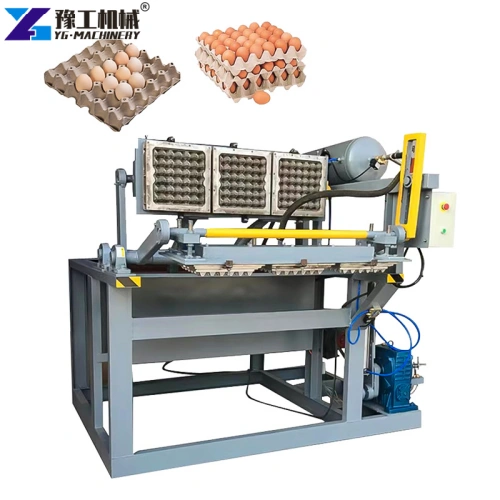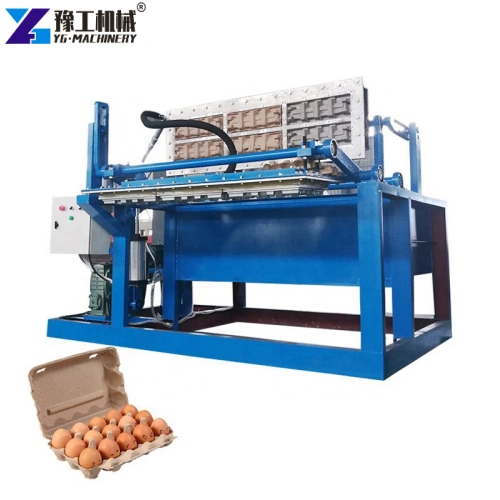


Pulp molding producers face growing demand for eco-friendly egg packaging while struggling with high labor costs, unstable output quality, and limited production capacity. Many startups cannot afford a fully automated line upfront, and established suppliers find it hard to scale without proportional increases in energy use and water consumption. This flexible egg carton maker adopts a modular design with gradient capacity options, allowing producers to start small and expand as orders grow. The system recycles over 90 percent of process water and accepts local waste paper as raw material, reducing both operating costs and environmental impact.
Product Full Technical Specifications Of Egg Carton Maker
| Model | Capacity/H | Power/hour | Paper Consumption/H | Water Consumption/H |
| YG-1500 – 4X1 | 1500pcs/h | 38kw | 120kg | 240kg |
| YG-2500 – 3X4 | 2500pcs/h | 55kw | 200kg | 400kg |
| YG-3000 – 4X4 | 3000pcs/h | 60kw | 240kg | 480kg |
| YG-4000 – 4X8 | 4000pcs/h | 95kw | 320kg | 640kg |
| YG-5000 -5X8 | 5000pcs/h | 95kw | 400kg | 800kg |
| YG-7000 -6X8 | 7000pcs/h | 120kw | 480kg | 960kg |
Selecting the right model depends on order volume, available factory space, and drying infrastructure. A small operation serving one local poultry farm may begin with a flip-mold unit, while a commercial supplier serving multiple distributors may require a rotary-drum configuration. Understanding typical egg tray machine price ranges helps buyers match capacity to budget without overspending on unused throughput. All models use vacuum forming technology and run on standard 380V three-phase industrial power.
Working Principle Of Egg Tray Machine Price
The production process begins when waste paper such as old cardboard boxes, newspapers, or office waste is soaked and pulped in a hydraulic pulper. The pulp is then diluted to a consistent slurry and pumped to the forming station, where a vacuum draws the material onto a perforated mold. The vacuum suction holds the wet pulp shape while excess water drains away. After forming, the molded articles are transferred to a drying system, either natural air drying, a brick-kiln setup, or a multi-layer metal drying line, depending on the buyer’s investment level. This staged process means that an egg carton maker can be configured with different drying options to match local climate and budget rather than forcing every buyer into the same fully automated package.


Core Product Features & Performance Advantages Of Egg Tray Maker Machine For Sale
- Gradient capacity lineup: Flip-mold models YG-1000 and YG-1500 suit startup projects with limited capital, while rotary-drum models YG-2500 through YG-7000 serve commercial factories needing higher output. Buyers can upgrade incrementally as order volume grows.
- Flexible drying options: Natural sun drying requires minimum investment but needs open space and depends on weather. Brick-kiln drying and multi-layer automatic metal drying lines offer higher throughput and year-round operation for wet climates.
- Water recycling system: Over 90 percent of process water is recovered and recirculated, reducing both water bills and discharge requirements.
- Quick mold change capability: One line can produce egg trays, egg cartons, fruit trays, coffee cup holders, industrial cushioning inserts, and seedling pots by swapping molds. Both aluminum and plastic molds are available.
- Energy efficiency: Compared with conventional units, power consumption is reduced by approximately 15 to 20 percent. Standardized modular construction makes wearing parts straightforward to replace.
- Low labor requirement: A complete line needs only 3 to 6 operators after short training, and local waste paper supplies keep raw material costs low.
Main Industry Application Scenarios Of Egg Carton Maker
Pulp molding equipment serves a range of packaging and agricultural businesses:
- Poultry farms: On-site production of egg trays for collecting and transporting fresh eggs to distributors
- Packaging suppliers: Manufacturing egg cartons, fruit trays and protective inserts for retail and wholesale distribution
- Agricultural product exporters: Producing molded pulp packaging for delicate fruits, vegetables and seafood during shipping
- Industrial component manufacturers: Making cushioning inserts for fragile electronic parts and hardware components
- Recycling operations: Converting waste paper into salable molded products as a secondary revenue stream
Product Purchase & Selection Guidance Of Egg Tray Machine Price
Buyers should evaluate several factors before selecting a configuration:
- Match capacity to current and near-term order volume. A startup serving one local farm may start with YG-1000, while a supplier to multiple distributors should consider YG-4000 or above.
- Assess available factory space. Natural drying needs large outdoor yards; automated drying lines need indoor space but operate reliably in any weather.
- Confirm electrical supply. All models require stable 380V three-phase industrial power, so verify plant power capacity before ordering.
- Plan for drying infrastructure. In rainy regions, natural sun drying is unreliable, and a drying room or multi-layer line should be budgeted.
- Note that molds are wearing parts and are not covered under the main machine warranty. Different products require custom molds.
- Process water must go through a sedimentation and recirculation system; direct discharge is not permitted by environmental regulations.
Frequently Asked Questions About Egg Tray Maker Machine For Sale


A: The pulper accepts waste cardboard, old newspapers, office waste paper, and similar recycled paper sources.
A: A standard production line requires 3 to 6 trained operators, depending on automation level and model capacity.
A: Yes. By changing molds, the same line can produce fruit trays, cup holders, industrial cushioning inserts, and seedling pots.
A: Buyers can choose natural sun drying, brick-kiln drying, single-layer drying room, or multi-layer automatic metal drying line based on budget and local climate.
Manufacturer Supply & Inquiry Information
We supply complete pulp molding production lines with capacity from 1000 to 7000 pieces per hour. Each system includes the main forming machine, hydraulic pulper, water recycling system, and selected drying equipment. We provide reference calculations for capacity, factory area, power supply, and drying requirements to help buyers configure the right solution. Overseas project references in Southeast Asia and Australia are available, along with English operation manuals and remote technical guidance.