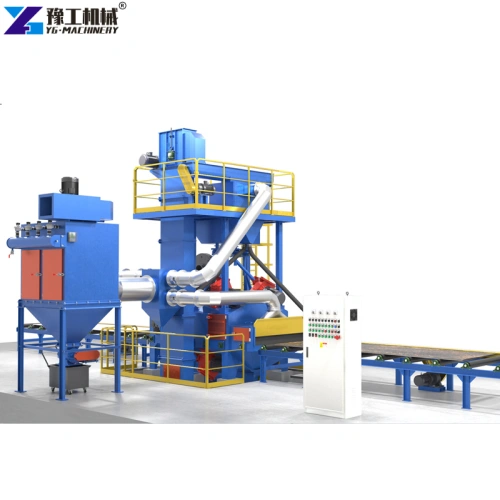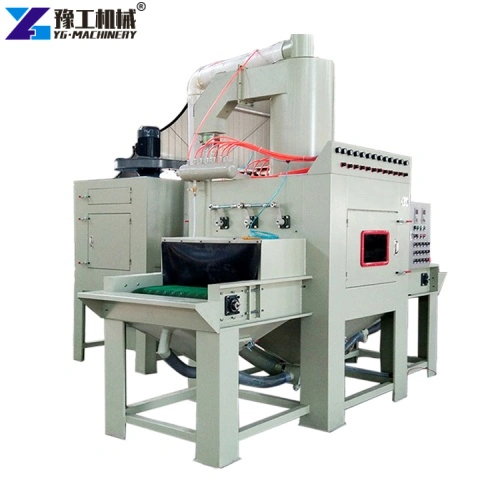
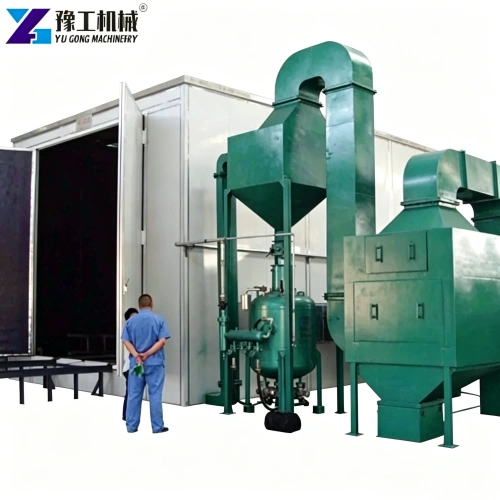
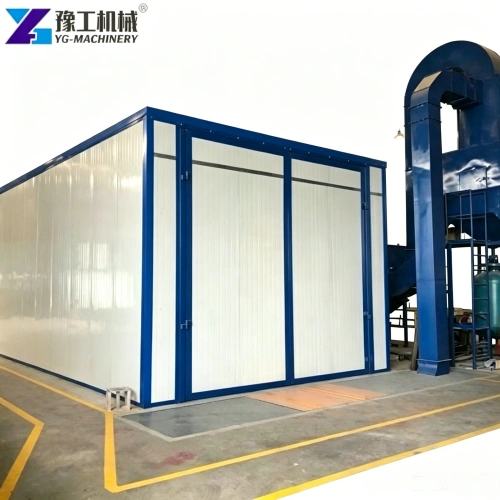
A sandblasting room, also known as a shot blasting room or sandblasting booth, is a fully enclosed industrial surface treatment equipment designed specifically for large/heavy workpieces. It uses high-speed abrasive jets (steel grit, brown corundum, glass beads, etc.) to achieve functions such as rust removal, oxide scale removal, old coating peeling, surface roughening (improving coating adhesion), and fatigue strengthening. If you are interested in sandblasting rooms, contact us immediately for customized solutions and accurate quotes, and to view more equipment photos, construction videos, and customer case studies!
SandBlasting Room Parameters
| Size of Blasting Room | Size of workpieces | Blasting Gun Qty |
| 6000×6000×5000mm | 3000×3000×2500mm | 2 |
| 6000×6000×6000mm | 3000×3000×3500mm | 2 |
| 8000×6000×5000mm | 5000×3000×2500mm | 2 |
| 8000×6000×6000mm | 5000×3000×3500mm | 2 |
| 10000×6000×6000mm | 7000×3000×3500mm | 2 |
| 15000×6000×6000mm | 12000×3000×3500mm | 2 |
| 15000×8000×6000mm | 12000×5000×3500mm | 2 |
| 18000×8000×6000mm | 15000×5000×3500mm | 4 |
| 18000×10000×8000mm | 15000×7000×5500mm | 4 |
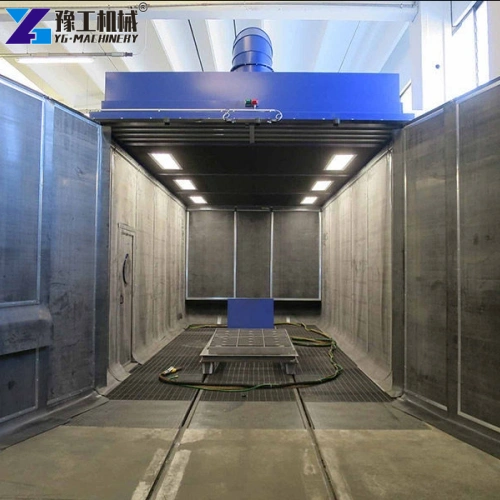
Working Principle of a Sandblasting Room
The sandblasting room’s workflow forms a closed-loop system of “blasting—recovery—separation—dust removal,” operating under negative pressure throughout to prevent dust leakage. The core principle consists of five main steps:
- Sandblasting Operation: Operators, wearing protective clothing and helmets, operate a high-pressure spray gun within the enclosed chamber. Compressed air (5-8 Bar pressure) accelerates the abrasive to 60-100 m/s, impacting the workpiece surface at high speed. The impact force peels away rust, oxide scale, oil, and other impurities, while simultaneously creating a uniformly rough surface.
- Abrasive Recovery: After operation, the abrasive and dust mix and fall by gravity into the recovery area at the bottom of the chamber. Depending on the recovery method, a scraper, spiral, or honeycomb floor conveyor can be used to transport the mixture to the elevator.
- Separation and Purification: The bucket elevator transports the mixture to the top separator, where air classification separates qualified abrasive, ultrafine dust, and coarse impurities. Qualified abrasive falls into the storage silo for recycling, while impurities and dust enter the dust removal system.
- Dust Treatment: Suspended dust inside the chamber enters the pulse jet dust collector through a negative pressure pipeline. The filter element filters out over 99.9% of ultrafine dust, ensuring the purified air meets emission standards and preventing environmental pollution.
- Intelligent Control: The PLC control system links the spray gun pressure, abrasive flow rate, and dust removal air volume, monitoring the equipment’s operating status in real time. It supports parameter presets and fault self-diagnosis, ensuring stable and efficient operation.
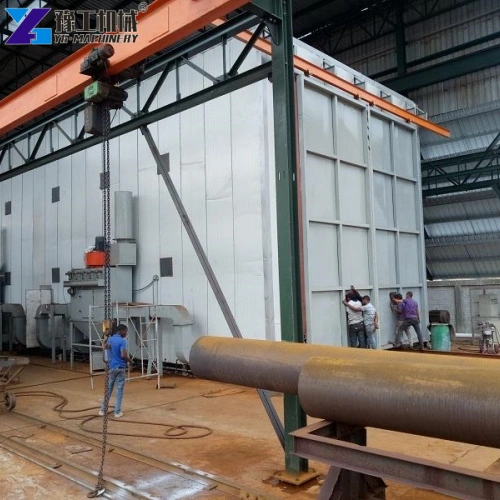
Types Of Sandblasting Room
Sandblasting booths are classified in various ways, but the core classifications are based on abrasive recovery methods, automation levels, structural forms, and workpiece conveying methods. Different types are suitable for different working conditions and budgets:
(I) Classification by Abrasive Recovery Method
- Pneumatic Recovery Sandblasting Booth: Relies on fan suction to recover abrasives, without mechanical transmission. It has a simple structure, small footprint, and low cost; however, its recovery efficiency is generally low, and abrasive loss is slightly higher. It is suitable for small sandblasting rooms and environments with limited space.
- Scraper Recovery Sandblasting Booth: Equipped with a mechanical scraper conveyor at the bottom, it is powerful, not easily clogged, and has a large load-bearing capacity; it requires a pit foundation, has a more complex structure, and is suitable for large trolley-type sandblasting booths and heavy workpiece processing.
- Honeycomb Recovery Sandblasting Booth: The floor uses a honeycomb perforation design, allowing for uniform material recovery across the entire surface, eliminating dead corners, ensuring smooth movement, low noise, and a high recovery rate; its cost is higher than the scraper type, and it is suitable for high-end fully automatic sandblasting rooms and factories with high environmental protection requirements.
(II)Classification by Automation Level
- Manual Sandblasting Booth: Manually operated spray guns; flexible operation, low cost, suitable for small-batch production of various products; disadvantages include high labor intensity and low efficiency, suitable for small and medium-sized enterprises and processing irregularly shaped workpieces.
- Semi-automatic Sandblasting Booth: Equipped with fixed spray guns and workpiece trolleys; manual assistance for loading and unloading; automatic reciprocating spraying; improved efficiency, reduced labor intensity, suitable for medium-batch, regular workpieces.
- Fully Automatic Sandblasting Booth: Integrates multi-axis robotic arms, roller/hook conveyor lines, and automatic loading and unloading mechanisms; fully unmanned operation; extremely high efficiency, uniform processing, suitable for large-scale standardized production, such as automotive parts and steel profiles.
(III) Classification by Structural Form
- Fixed Sandblasting Booth: Concrete or steel structure foundation, permanently fixed installation; large volume, strong stability, suitable for heavy workpieces; disadvantages include immobility, high infrastructure costs, and long construction period.
- Portable (Containerized) Sandblasting Booth: Based on standard shipping containers, modular design, no infrastructure required, can be placed directly on flat ground, and can be installed and put into operation in 2-3 hours; flexible transport capability, suitable for temporary projects, rented factories, and site-constrained scenarios.
(IV) Classification by Workpiece Conveying Method
- Trolley-type Sandblasting Booth: Workpieces are placed on trolleys to enter and exit the booth; strong load-bearing capacity (up to 50 tons or more), suitable for heavy steel structures, wind turbine towers, and construction machinery.
- Through-type Sandblasting Booth: Roller conveyor continuously transports workpieces, assembly line operation, high speed and high output, suitable for long and narrow workpieces such as steel plates, H-beams, profiles, and containers.
- Hook-type Sandblasting Booth: Workpieces are suspended for transport, avoiding collisions, suitable for thin-walled parts, irregularly shaped parts, automotive parts, and other easily damaged workpieces.
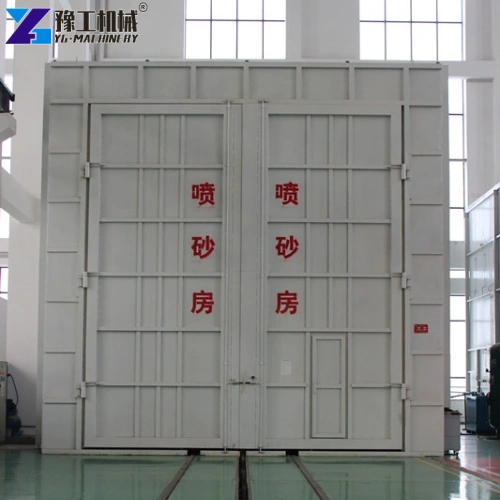
Key Features of Sandblasting Room
- Excellent Treatment Results and Controllable Quality: Achieves Sa2.5 (near-white) cleanliness, controllable surface roughness (25-100μm), and improves coating adhesion by over 30%; 360° blasting with no dead angles, ensuring uniform treatment and eliminating missed areas and color differences.
- Environmentally Friendly and Compliant: Fully enclosed negative pressure design prevents dust leakage; abrasive recycling rate exceeds 98%, reducing material waste, eliminating chemical pollution, and replacing traditional acid pickling processes.
- High Adaptability and Flexible Customization: Booth dimensions can be customized according to workpiece size, weight, and shape (length 6-18m, width 6-10m, height 5-8m); compatible with various abrasives such as steel grit, brown corundum, and glass beads; suitable for workpieces made of metal, stone, glass, and plastic.
- Stable and Reliable Operation: Core components (spray gun, scraper, elevator) are made of wear-resistant materials, and key parts are lined with wear-resistant plates, ensuring impact resistance, wear resistance, and a long service life. Equipped with explosion-proof, anti-static, emergency stop, and interlocking devices, it avoids the risks of dust explosions and mechanical injuries.
- Cost Optimization: Compared to chemical pickling, there is no wastewater, waste gas, or waste residue emission, and no need for environmentally friendly treatment agents. Abrasives are recycled, reducing consumable costs by 60%. Automated design reduces labor costs, and long-term operation features low energy consumption and simple maintenance.
Choose A Professional Sandblasting Room Manufacturer – YG
Driven by both green and intelligent manufacturing in industry, environmental protection, automation, and high efficiency have become the core development trends of surface treatment equipment. As the core equipment for surface treatment of large workpieces, sandblasting rooms not only solve the pain points of high pollution, low efficiency, and poor quality of traditional processes, but also improve product corrosion resistance, reduce operating costs, and help enterprises achieve environmental compliance.
Choosing a YG sandblasting room is not just choosing a piece of equipment, but also choosing professional technical solutions, stable product quality, and comprehensive after-sales support. It helps businesses improve production efficiency, optimize product quality, reduce operating costs, and achieve green and sustainable development. In the future, YG will continue to innovate and optimize product performance, providing the global industrial surface treatment industry with higher quality, more efficient, and more environmentally friendly equipment solutions. Contact us now!