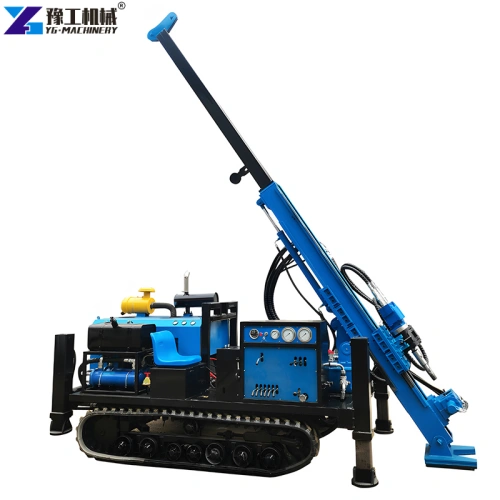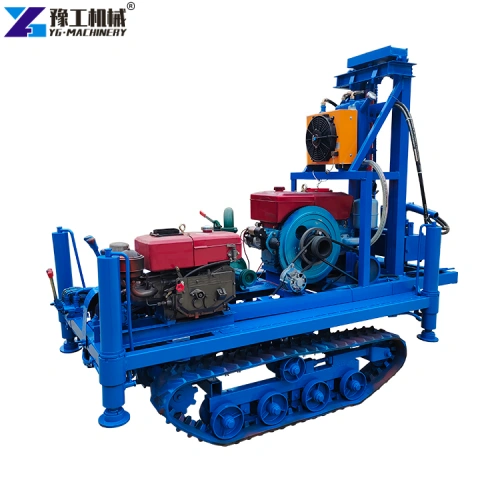
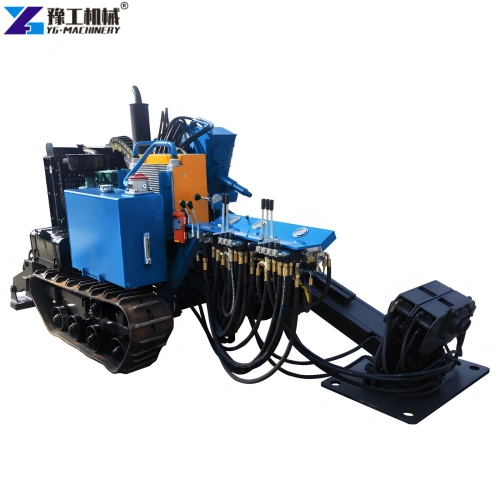
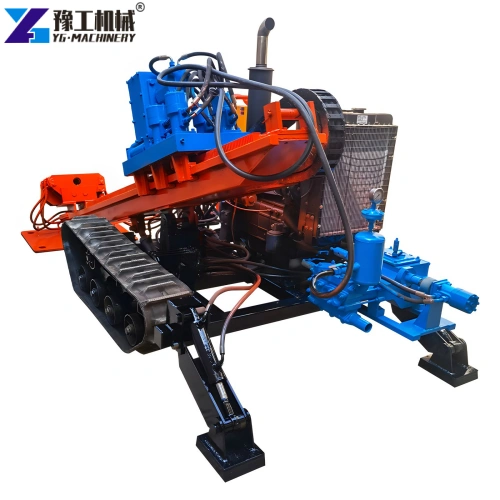
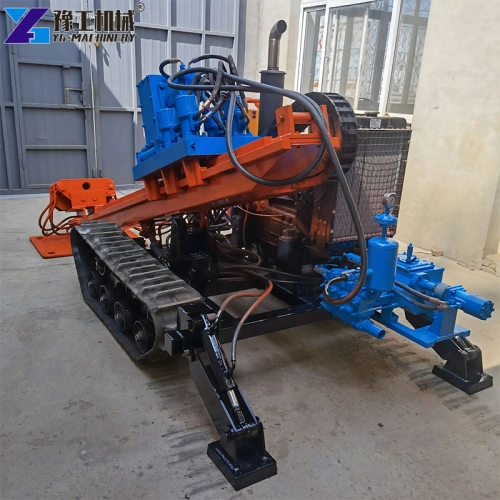
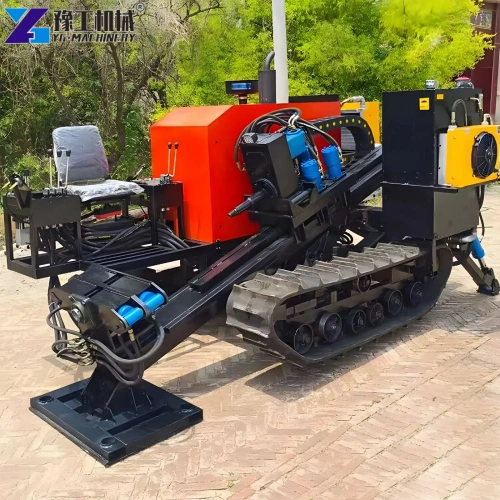
In municipal pipeline networks, gas, power, and telecommunications, water supply and drainage, and oil pipeline projects, horizontal directional drilling equipment (HDD) is excavation-free, highly efficient, and environmentally friendly construction equipment. The equipment features a compact, modular design, a small footprint, and can operate in confined spaces, even over obstacles such as rivers, railways, and buildings. The entire machine is easy to transport, requiring no large lifting equipment, significantly reducing relocation and site costs. If you are also looking for suitable equipment for your project, please contact us immediately for product information.
Horizontal Directional Drilling Equipment Technical Parameter
| Model | YG-160A | YG-180 | YG-280 | YG-320 | YG-320A |
| Engine rated power | 100KW | 97KW | 160KW | 140KW/160KW | 160KW |
| Push and pull | Cylinder | Motor | Motor | Cylinder | Motor |
| Maximum drag/feed force | 160/100KN | 180/180KN | 280/280KN | 320/320KN | 320/320KN |
| The maximum torque of the powerhead | 5000N.n | 6000N.n | 10000N.n | 12000N.n | 12000N.n |
| Powerhead speed | 0-180r/min | 0-140r/min | 0-120r/min | 0-140r/min | 0-140r/min |
| Moving speed of powerhead | 30m/min | 20m/min | 20m/min | 20m/min | 20m/min |
| Moving speed of the powerhead | Φ600mm | Φ600mm | Φ750mm | Φ800mm | Φ800mm |
| Drill rod length (single) | 3m | 3m | 3m | 3m | 3m |
| Drill pipe diameter | Φ60mm | Φ60mm | Φ73mm | Φ73mm | Φ73mm |
| Drill pipe diameter | 10-23° | 10-22° | 10-23° | 10-20° | 10-20° |
| Maximum mudflow | 160L/min | 250L/min | 320L/min | 320L/min | 320L/min |
| Maximum mud pressure | 100bar | 80bar | 80bar | 80bar | 80bar |
| Overall quality | 6700kg | 8500kg | 12500kg | 11500kg | 11200kg |
| Dimension(length*width*height) | 5700*1820*2400mm | 6400*2270*2340mm | 7100*2260*2450mm | 7100*2250*2450mm | 7100*2250*2550mm |
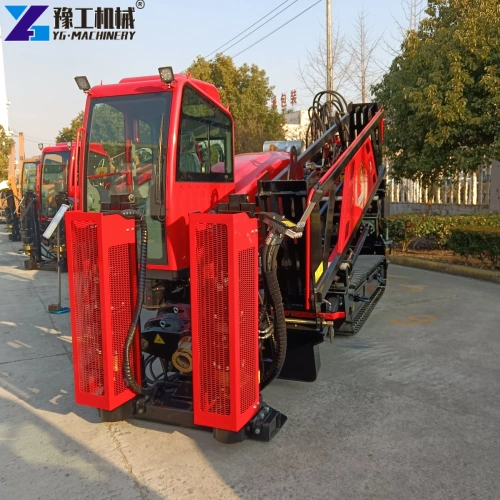
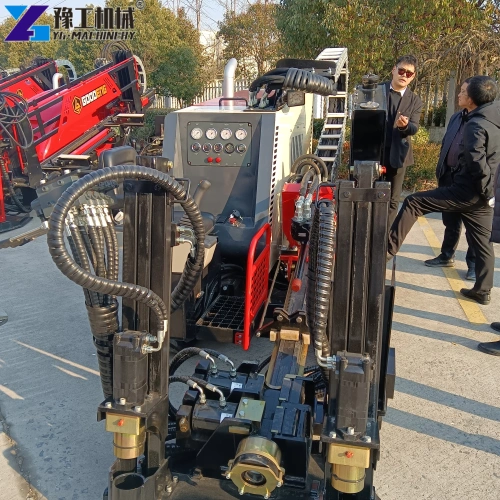
Traditional Excavation vs. Horizontal Directional Drilling (Key Differences)
Traditional excavation and horizontal directional drilling are two mainstream methods for laying underground pipelines. The core differences lie in whether or not surface excavation is required, construction efficiency, and environmental impact.
1. Traditional Excavation Construction
- Construction Principle: Excavate the entire trench, lay the pipeline, and backfill to restore the original surface.
- Construction Method: Causes significant damage to road surfaces, green spaces, and ground facilities, resulting in traffic closures.
- Applicable Scenarios: Open suburbs, areas without important ground facilities, shallow, short-distance pipelines.
- Advantages: Simple equipment, low technical threshold, suitable for shallow direct burial projects.
- Disadvantages: Environmental damage, significant pollution, traffic congestion, long construction period, high cost, and complex remediation.
2. Horizontal Directional Drilling (HDD)
- Construction Principle: Horizontal directional drilling (HDD) is a trenchless underground pipeline laying technology. Its core principle is to first drill a small-diameter pilot hole according to the design trajectory, then gradually enlarge the hole, and finally pull the pipeline back into the hole. The entire process does not require large-area excavation of the ground.
- Construction Method: Trenchless operation, requiring only two small sites: the entry point and the exit point.
- Applicable Scenarios: Urban roads, crossing rivers/railways/buildings, and environmentally sensitive areas.
- Advantages: Does not damage the ground, does not affect traffic, environmentally friendly and pollution-free, fast construction speed, high precision, low cost, not limited by season.
- Disadvantages: Higher equipment investment than small excavation equipment; limited adaptability to complex hard rock formations.
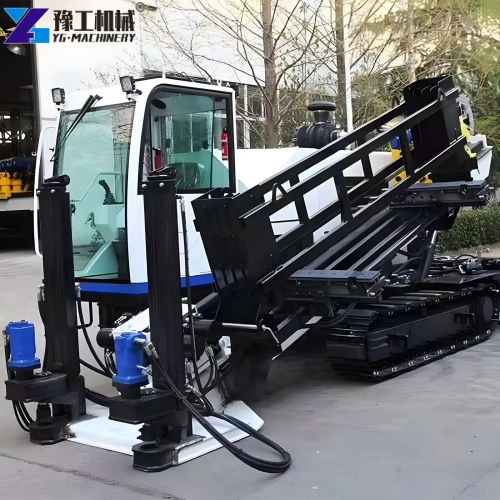
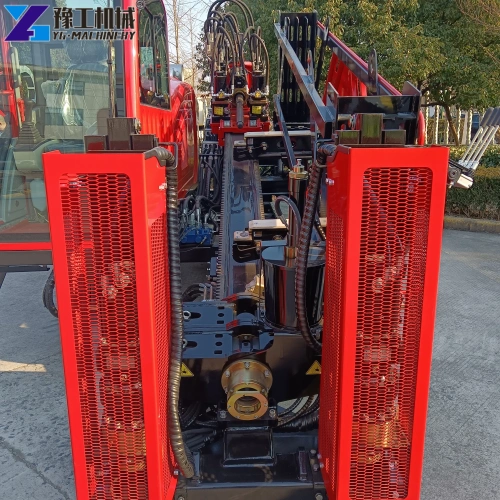
Selection Guide for 3 Types of YG Horizontal Directional Drilling Rigs
1. Small Horizontal Directional Drilling Rig (27-150 tons pullback force)
- Core Features: Compact size, high mobility, easy operation, high cost-effectiveness
- Applicable Scenarios: Urban communities, street renovation, short-distance (≤300 meters) communication, power, and water supply/drainage branch pipes
- Advantages: Strong adaptability to narrow spaces, fast relocation, suitable for small to medium-sized municipal projects
2. Medium Horizontal Directional Drilling Rig (150-450 tons pullback force)
- Core Features: Powerful engine, stable performance, intelligent directional control, strong comprehensive capabilities
- Applicable Scenarios: Municipal main pipelines, crossing ordinary roads, medium-sized rivers, gas/water supply main pipelines
- Advantages: Widest applicability, optimal balance between efficiency and cost, mainstream choice for engineering companies
3. Large Horizontal Directional Drilling Rig (450-600 tons + pullback force)
- Core Features: Ultra-large power, long-distance crossing, hard rock adaptability, high degree of automation
- Applicable Scenarios: Ultra-long distance (≥800 meters) crossings of major rivers, highways, railways, and long-distance oil pipelines
- Advantages: Capable of completing ultra-large trenchless crossing projects; high technical barriers; top-tier construction capabilities.
Frequently Asked Questions (FAQ) about Horizontal Directional Drilling Rigs
1. What geological formations are suitable for horizontal directional drilling equipment?
Suitable for sandy soil, clay, silt, soft rock, weathered rock, etc. Not suitable for high-water-content silt and large-diameter gravel layers.
2. What is the maximum length and size of pipeline that the YG HDD rig can lay?
It is suitable for steel pipes and PE pipes with diameters of Φ300~Φ1200mm, with a maximum laying length of up to 1500m. It is adaptable to various soil conditions, from soft soil to hard rock, and has broad application prospects.
3. Can HDD rigs cross rivers and railways?
Yes. When crossing rivers, the pipeline can be buried 6-18 meters below the riverbed without affecting navigation or damaging dams. Crossing railways does not require stopping operations and has no impact on traffic or structure, making it the preferred trenchless crossing solution.
4. Will horizontal directional drilling damage the ground environment?
No. The entire process is trenchless, with only two small-scale construction points for entry and exit, without damaging roads, green spaces, or underground facilities. It is environmentally friendly and pollution-free, perfectly solving the problem of noise pollution from urban construction.
5. Are horizontal directional drilling rigs prone to jamming or rod breakage?
Under proper operation, this is unlikely. Equipped with an intelligent directional control system and high-quality drill pipe, it allows for real-time monitoring and adjustment. In complex geological formations, staged reaming and optimised mud ratios effectively reduce the risk of stuck drill bits and broken drill pipes.
6. Is the HDD rig fuel-intensive?
Compared to traditional excavation, the overall cost is lower. Although the equipment consumes fuel, it saves on huge expenses such as excavation, backfilling, road repair, traffic control, and environmental remediation, reducing overall construction costs by more than 30%, resulting in significant long-term economic benefits.
7. Is the HDD rig difficult to maintain?
Maintenance is simple. The modular design of core components makes it easy to inspect and repair; daily maintenance only requires lubrication, cleaning, and replacement of easily worn parts, eliminating the need for a professional maintenance team and significantly reducing operating costs