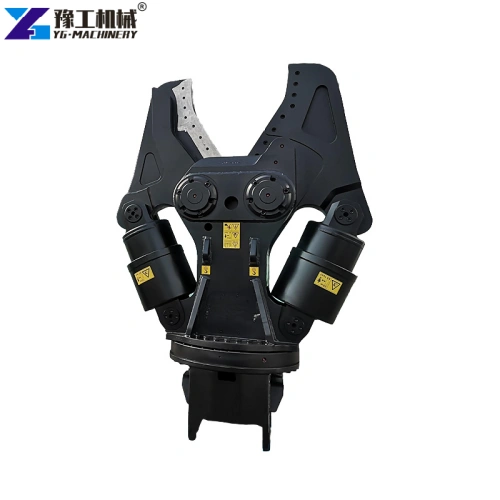
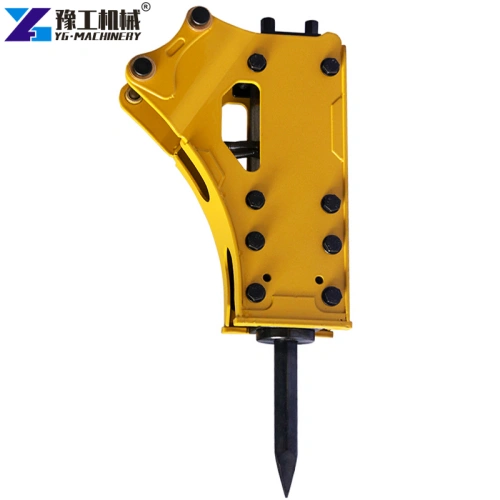
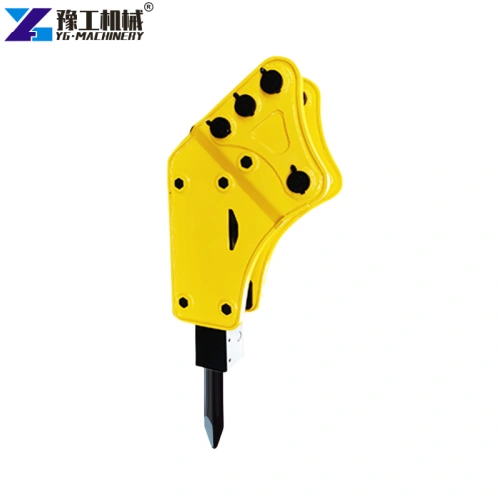
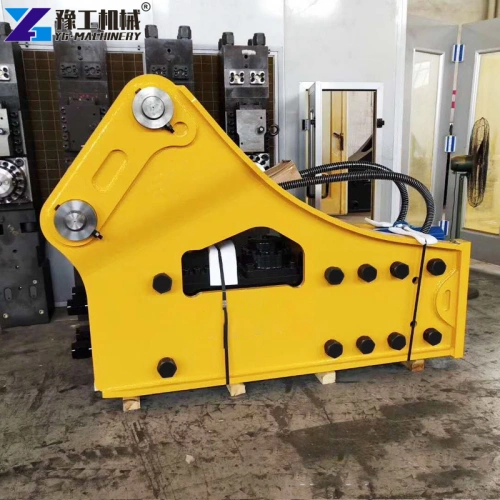
Excavator concrete breakers are crushing devices powered by the excavator’s hydraulic system. As a core auxiliary tool for excavators, they are precisely compatible with the main excavator, requiring no additional power unit and allowing for quick installation and operation. Their core components include the hammer body, chisel, directional valve, and accumulator. The chisel, as the core component in direct contact with materials, undergoes a special heat treatment process, resulting in high strength and wear resistance, capable of handling crushing requirements of varying hardness. In the engineering construction field, excavator concrete breakers are indispensable core auxiliary equipment. For more product details, please contact us immediately.
Excavator Concrete Breaker Attachment Parameter
| Model | ChiselDiameter | SuitableCarrierWeight | Main bodyWeight | OperatingPressure | HydraulicOil Flow | Blow Frequency | HoseDiameter |
| mm | Ton | kg | Kg/cm 2 | I/min | bpm | inch | |
| YG350 | 35 | 0.5-1 | 40 | 90-120 | 15-25 | 800-1300 | 1/2 |
| YG400 | 40 | 1-3 | 53 | 90-120 | 15-25 | 800-1300 | 1/2 |
| YG450 | 45 | 1.2-3.0 | 67 | 90-120 | 20-30 | 700-1200 | 1/2 |
| YG530 | 53 | 2.5-4.5 | 85 | 90-120 | 25-50 | 600-1100 | 1/2 |
| YG600 | 60 | 2-5 | 140 | 90-120 | 25-50 | 600-1100 | 1/2 |
| YG680 | 68 | 4-7 | 152 | 110-140 | 40-70 | 500-900 | 1/2 |
| YG750 | 75 | 6-9 | 210 | 120-150 | 50-90 | 400-800 | 1/2 |
| YG850 | 85 | 7-14 | 278 | 130-160 | 60-100 | 400-800 | 3/4 |
| YG100 | 100 | 10-15 | 475 | 150-170 | 80-110 | 350-700 | 3/4 |
| YG1250 | 125 | 15-18 | 616 | 150-170 | 80-110 | 350-700 | 3/4 |
| YG1350 | 135 | 16-26 | 846 | 160-180 | 130-150 | 400-800 | 1 |
| YG1400 | 140 | 18-26 | 916 | 160-180 | 120-180 | 350-500 | 1 |
| YG1400A | 140 | 18-26 | 952 | 160-180 | 120-180 | 350-500 | 1 |
| YG1500 | 150 | 27-35 | 1088 | 160-180 | 150-190 | 350-700 | 1 |
| YG1550 | 155 | 28-36 | 1309 | 180-200 | 200-260 | 250-400 | 1-1/4 |
| YG1650 | 165 | 30-40 | 1438 | 180-200 | 200-260 | 250-400 | 1-1/4 |
| YG1650P | 165 | 30-40 | 1586 | 180-200 | 200-260 | 250-380 | 1-1/4 |
| YG1750 | 175 | 35-40 | 1929 | 180-200 | 210-290 | 200-350 | 1-1/4 |
| YG1850 | 185 | 35-45 | 2411 | 190-220 | 220-270 | 200-250 | 1-1/4 |
| YG1990 | 190 | 40-55 | 2626 | 190-220 | 220-290 | 180-200 | 1-1/4 |
| YG2100 | 210 | 60-80 | 3396 | 200-240 | 290-350 |
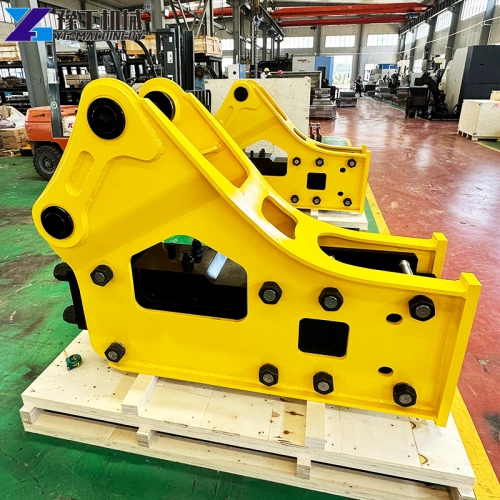
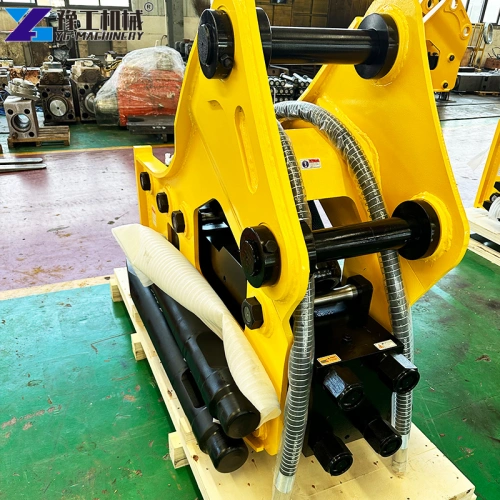
Working Principle of Excavator Concrete Breaker
The core working principle of an excavator concrete breaker is “hydraulic transmission + nitrogen energy storage,” with a working cycle consisting of four stages: “energy storage—acceleration—impact—reset.”
- Return Acceleration Stage: High-pressure oil from the excavator’s hydraulic system flows into the piston’s front chamber, thereby pushing the piston upward. Meanwhile, nitrogen in the rear chamber is compressed to finish energy storage.
- Return Braking Stage: After the piston reaches the predetermined position, the reversing valve switches the oil circuit, cutting off the high-pressure oil. The reaction force of the nitrogen stops the piston from moving upwards.
- Stroke Acceleration Stage: The nitrogen in the rear chamber expands adiabatically, pushing the piston downwards at high speed, converting the stored energy into kinetic energy.
- Impact Completion Stage: The piston impacts the chisel at high speed, transferring the impact force to hard materials to achieve breakage; after the piston rebounds, the reversing valve resets, and the next cycle begins.
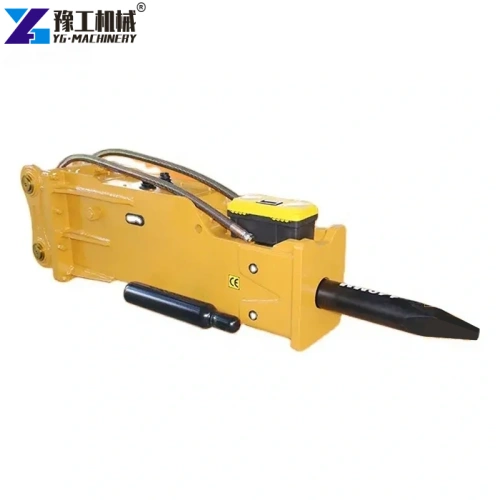
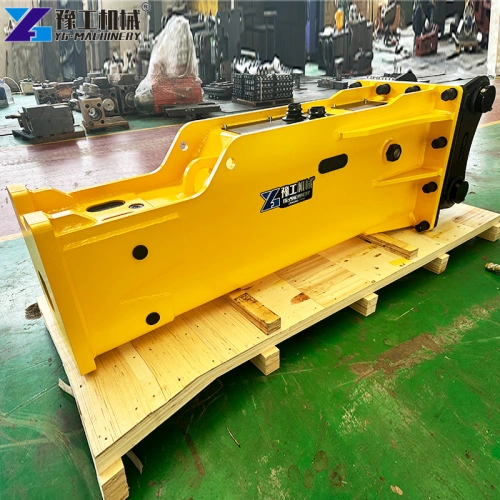
Core Advantages of Excavator Concrete Breaker
1. Wide Adaptability, Flexibility, and Convenience
The excavator hydraulic breaker is compatible with various excavators ranging from 6 to 45 tons. Standardized connecting brackets allow for quick adaptation to mainstream brands; quick-connect couplings eliminate the need for manual bolt removal, enhancing operational flexibility. Smaller models are suitable for confined spaces, solving the problem of large equipment being unable to access the site, and integrating crushing and screening functions, reducing process costs.
2. High Efficiency and Energy Saving, Strong Crushing Force
Utilizing the excavator’s own hydraulic system, no additional power source is required, resulting in significant energy savings; the high-frequency impact design far exceeds the efficiency of traditional equipment, enabling rapid processing of hard materials and shortening construction time. Core components are made of wear-resistant alloys, with a normal service life exceeding 6000 hours, reducing maintenance costs.
3. Safe and Stable, with Controllable Losses
Equipped with a rubber + spring dual shock absorption structure, reducing damage to the excavator body and boom, and operator fatigue, a hydraulic overload protection device enhances operational safety. Noise and vibration are well controllable. Furthermore, it causes less environmental impact than blasting, thus making it ideal for urban areas and nearby construction sites.
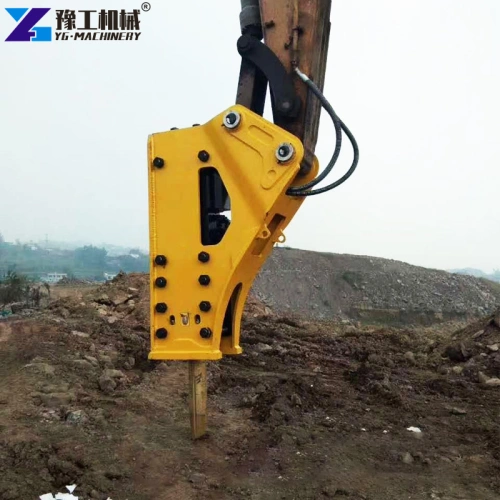
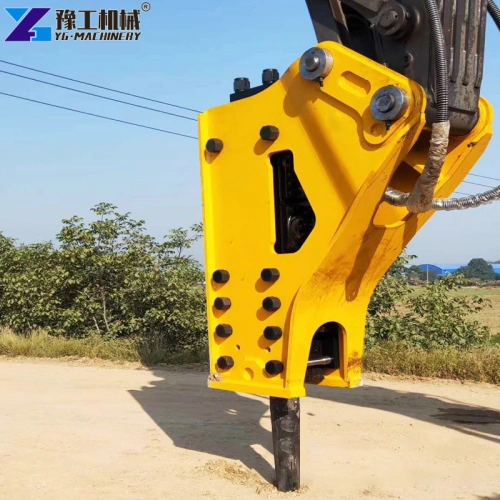
Application Scenarios of Excavator Hydraulic Breakers
- Mining: High-powered excavator hydraulic breakers are used for ore stripping, large ore crushing, mine slope trimming, and waste rock removal. They eliminate the need for explosives, avoiding blasting risks, and are suitable for mining near residential areas and major transportation routes.
- Municipal Engineering: Miniature excavator hydraulic breakers are primarily used for road repair, trench excavation, old building demolition, and concrete pavement breaking. Their compact size makes them suitable for narrow urban areas, and attachments can improve operational precision.
- Construction: Used for breaking hard bedrock in foundation pits, demolishing old buildings, and clearing pile foundations. The smaller models can pre-screen materials, improving construction efficiency, and can also operate precisely and safely in bridge and tunnel demolition and excavation.
- Other Applications: Used for river dredging and dam maintenance in agriculture and water conservancy, rock breaking and site leveling in landscape engineering, and obstacle removal in emergency rescue. Their flexibility and powerful breaking force help various projects proceed efficiently.
Excavator Hydraulic Breaker Common Problems and Repair Solutions
1. Weak striking power and slow frequency.
Mainly caused by hydraulic system failure, abnormal nitrogen pressure, or mechanical wear.
Solution: First, check the hydraulic oil flow and pressure. Clean or replace clogged filters and worn main pumps. Adjust pilot pressure to 3-4 MPa and system pressure to 18-22 MPa. Then, check the nitrogen pressure and add nitrogen to the standard value of 1.2-1.6 MPa (compressed air is prohibited). If the pressure is too high, release excess nitrogen. Finally, check the wear of the chisel and bushings; replace them if wear exceeds the standard.
2. Abnormal noise during operation
Mostly caused by wear of mechanical parts or improper assembly, such as excessive clearance between the chisel and bushing, or damage to the piston or cylinder.
Solution: Stop the machine and check the chisel swing amplitude. If the clearance is >2mm or the chisel wear is >5mm, replace it immediately. Disassemble and inspect the piston sealing ring and cylinder wall. Repair or replace if scratches or damage are found. Also, check the connecting bolts and tighten any loose parts.
3. Hydraulic Oil Leakage
This mainly occurs at high-pressure oil pipe joints or the internal cylinder seals of the hydraulic breaker.
Solution: Check for ruptured oil pipes and loose joints; replace damaged oil pipes and seals. If the leakage is internal to the cylinder, disassemble and repair the sealing components, replace aged seals, and replace contaminated hydraulic oil.
4. Incompatibility with Excavator
This is often caused by incompatible connecting brackets or improper installation of hydraulic breaker accessories.
Solution: Confirm that the hydraulic breaker model matches the excavator tonnage; replace with a compatible connecting bracket. Check the installation of hydraulic breaker accessories such as quick connectors to ensure secure connections and unobstructed oil passages.