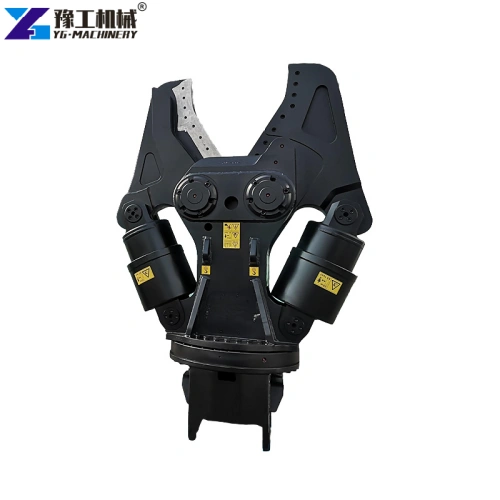
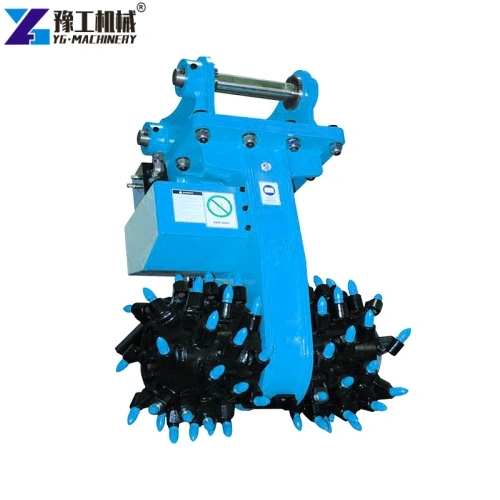
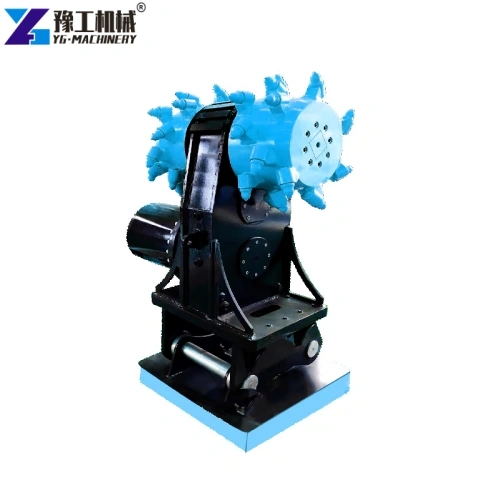
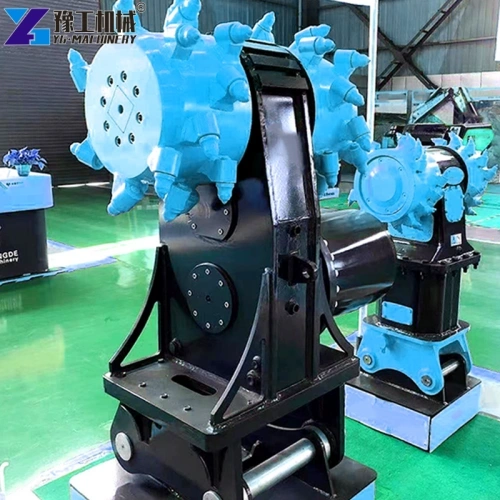
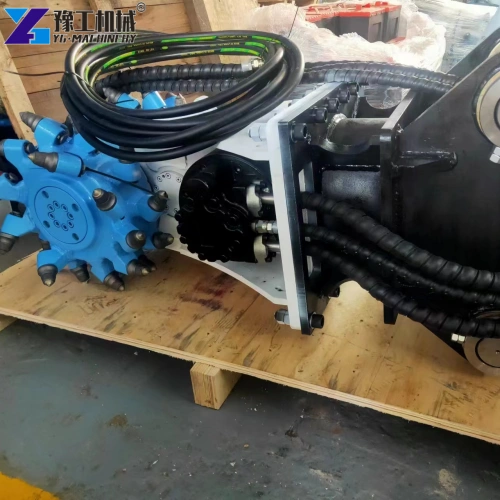
The excavator drum cutter is a high-end accessory driven by the excavator’s hydraulic system, mainly composed of five components: a hydraulic motor, a reduction gearbox, a rotating drum, carbide cutting teeth, and a connecting bracket. Unlike the impact-type operation of traditional hydraulic breakers, it uses continuous rotary cutting as its core principle. The densely arranged tungsten carbide cutting teeth on the drum surface can efficiently cut hard materials such as rock, concrete, asphalt, and frozen soil. With standardized excavator drum cutter accessories (such as quick-connect couplings, dust covers, and cutting tooth removal tools), it can be quickly adapted to various excavators ranging from 3 tons to 45 tons, achieving “one machine, multiple uses,” making it one of the most competitive and efficient accessories in the drum cutter market. Want to learn more? Please contact us now.
Excavator Drum Cutter Parameter
| Model | YG140 | YG160 | YG180 | YG240 |
| H | 650mm | 820mm | 830mm | 1395mm |
| W | 410mm | 650mm | 780mm | 960mm |
| D | 390mm | 460mm | 480mm | 620mm |
| Excavator weight | 5~10T | 10~15T | 15~21T | 20~24T |
| Max power | 22Kw | 45Kw | 55Kw | 65Kw |
| Speed | 0~120r/min | 0~100r/min | 0~80r/min | 0~90r/min |
| Flow | 40L/min | 100~110L/min | 130~180r/min | 200~250r/min |
| Max Torque | 3200N.m | 5400N.m | 5600N.m | 12800N.m |
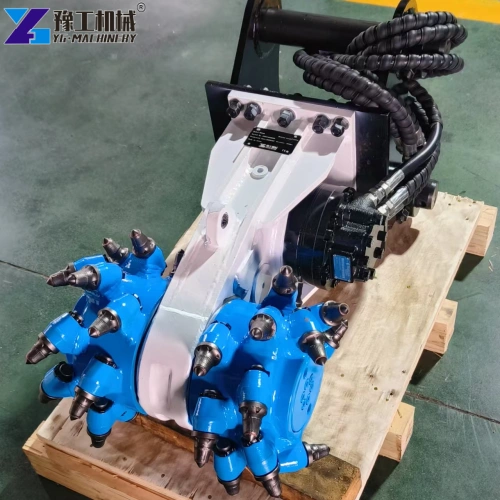
Working Principle of Excavator Drum Cutter
The core working principle of the excavator drum cutter is “hydraulic power conversion → torque output → rotary cutting → material crushing.” The entire process is impact-free and low-vibration, achieving precise crushing through continuous cutting. Specifically, it can be broken down into four core stages:
- Power Transmission Stage: The excavator’s hydraulic system outputs high-pressure hydraulic oil, driving the built-in hydraulic motor at high speed. The high speed is converted into high torque by a reduction gearbox and transmitted to the rotating drum, ensuring sufficient cutting force.
- Rotary Cutting Stage: Under the action of torque, the drum rotates at a uniform speed (30-80 rpm). The tungsten carbide alloy cutting teeth on the surface continuously contact and compress hard materials, using shearing and grinding forces to cut and crush rocks and concrete layer by layer.
- Material Discharge Stage: The debris generated from cutting naturally falls off with the rotation of the drum. The particles are uniform and fine (5-20mm in diameter), allowing for direct backfilling or transportation without secondary crushing, significantly improving construction efficiency.
- Parameter Adjustment Stage: By adjusting the excavator’s hydraulic flow and pressure, the drum speed and cutting torque can be flexibly controlled, adapting to materials of different hardness, such as soft rock, hard rock, and concrete, ensuring a balance between cutting efficiency and equipment lifespan.
Compared to the impact crushing of a hydraulic breaker (which is prone to vibration cracks and flying debris), the rotary drum cutter’s cutting operation is more controllable and will not damage the stability of surrounding structures, making it particularly suitable for sensitive scenarios such as urban areas and tunnels.
Application Scenarios of Excavator Drum Cutters
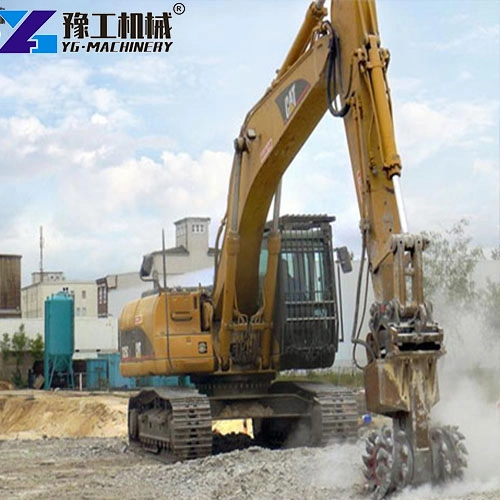
- Tunnel Engineering: Used for tunnel contour trimming, face breaking, initial support removal, and tunnel widening. Low vibration avoids damaging surrounding rock stability, and precise cutting ensures tunnel dimensions meet standards. It is a core piece of equipment for subway tunnels, highway tunnels, and mine roadway construction.
- Municipal Engineering: Mini excavator drum cutters are suitable for narrow urban spaces and are used for road repair, concrete pavement breaking, trench excavation, old building demolition, and pipeline renovation. Low noise and low vibration do not affect the lives of surrounding residents or building safety.
- Mining: Replaces traditional blasting processes for cutting soft to medium-hard rock, ore body stripping, block trimming, and slope clearing. No blasting risks, no vibration damage, improves ore utilization, and meets the requirements of green mine construction.
- Building Construction: Used for foundation pit rock breaking, pile foundation trimming, reinforced concrete demolition, building contour grinding, and floor slab breaking. Precise control of the breaking range avoids damage to the main structure, making it suitable for the refined demolition of high-rise buildings and commercial complexes.
- Water Conservancy and Slope Engineering: Used for river dredging, dam repair, slope cutting, and slope protection. It can precisely control the slope and depth, and when used with excavator drum cutter attachments (such as dustproof devices), it achieves environmentally friendly construction.
- Special Applications: Can be used for frozen soil breaking, underwater demolition, stone processing, and emergency rescue obstacle removal.
Common Problems and Solutions for Excavator Drum Cutters
1. Rapid Wear and Short Service Life of Cutting Teeth
Causes: Mismatch between cutting tooth model and cutting material; excessive hydraulic flow or speed; failure to add grease in time.
Solutions: Select cutting teeth according to material hardness (tungsten carbide alloy cutting teeth for hard rock, standard cutting teeth for soft rock); adjust hydraulic flow to the rated range (40-100L/min); add grease every 8 hours of operation to reduce cutting tooth wear.
2. Weak Cutting Power and Reduced Efficiency
Causes: Insufficient hydraulic pressure in the excavator; insufficient or damaged gearbox oil; jammed drum bearings.
Solutions: Check the excavator’s hydraulic pressure and adjust it to 16-22MPa; regularly check the gearbox oil level and change the special gear oil every 1000 hours; clean debris from the drum bearings, and replace the bearings if the jamming is severe.
3. Abnormal noise and vibration during operation
Causes: Loose or detached cutting teeth; worn gears inside the gearbox; loose connecting bracket bolts.
Solutions: Stop the machine and inspect the cutting teeth; tighten loose cutting teeth and replace detached cutting teeth; disassemble the gearbox and repair worn gears; retighten the connecting bracket and hydraulic motor fixing bolts to ensure a secure connection.
4. Hydraulic oil leakage
Causes: Aging and ruptured oil pipes; worn seals; loose joints.
Solutions: Replace aging high-pressure oil pipes; replace gearbox and hydraulic motor seals; tighten oil pipe joints and apply sealant to ensure no leakage.